


Page 47 - IJAMD-2-3
P. 47
International Journal of AI for
            Materials and Design                                             Biomimetic ML for AFSD aluminum properties


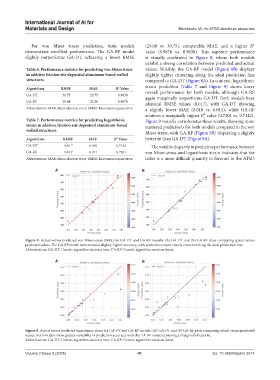
              For  von Mises  stress  prediction,  both models   (29.08  vs. 30.75), comparable MAE, and a higher  R²
            demonstrate excellent performance. The GA-RF model   value (0.9676  vs. 0.9638). This superior performance
            slightly outperforms GA-DT, achieving a lower RMSE   is  visually  confirmed in  Figure  8,  where  both models
                                                               exhibit a strong correlation between predicted and actual
            Table 6. Performance metrics for predicting von Mises stress   values. Notably, the GA-RF model (Figure  8B) displays
            in additive friction stir deposited aluminum‑based walled   slightly tighter clustering along the ideal prediction line
            structures                                         compared to GA-DT (Figure 8A). In contrast, logarithmic

            Algorithms     RMSE        MAE        R  Value     strain prediction (Table 7 and  Figure  9) shows lower
                                                   2
            GA-DT           30.75      22.75       0.9638      overall performance for both models, although GA-RF
                                                               again marginally outperforms GA-DT. Both models have
            GA-RF           29.08      23.20       0.9676      identical RMSE values (0.017), with GA-DT showing
            Abbreviations: MAE: Mean absolute error; RMSE: Root mean square error.  a slightly lower MAE (0.010  vs. 0.011), while GA-RF
                                                               achieves a marginally higher R² value (0.7201 vs. 0.7142).
            Table 7. Performance metrics for predicting logarithmic   Figure 9 visually corroborates these results, showing more
            strain in additive friction stir deposited aluminum‑based   scattered predictions for both models compared to the von
            walled structures
                                                               Mises stress, with GA-RF (Figure 9B) displaying a slightly
            Algorithms      RMSE       MAE        R  Value     better fit than GA-DT (Figure 9A).
                                                   2
            GA-DT           0.017      0.010      0.7142         The notable disparity in predictive performance between
            GA-RF           0.017      0.011      0.7201       von Mises stress and logarithmic strain indicates that the
            Abbreviations: MAE: Mean absolute error; RMSE: Root mean square error.  latter is a more difficult quantity to forecast in the AFSD
                         A                                   B


            Figure 8. Actual versus predicted von Mises stress (MPa) for GA-DT and GA-RF models: (A) GA-DT and (B) GA-RF plots comparing actual versus
            predicted values. The GA-RF model demonstrates slightly higher accuracy, with predictions more closely clustered along the ideal prediction line.
            Abbreviations: GA-DT: Genetic algorithm-decision tree; GA-RF: Genetic algorithm-random forest.

                         A                                   B


            Figure 9. Actual versus predicted logarithmic strain for GA-DT and GA-RF models: (A) GA-DT and (B) GA-RF plots comparing actual versus predicted
            values. Both models show greater variability in prediction accuracy, with the GA-RF model achieving a marginally better fit.
            Abbreviations: GA-DT: Genetic algorithm-decision tree; GA-RF: Genetic algorithm-random forest.

            Volume 2 Issue 3 (2025)                         41                             doi: 10.36922/ijamd.5014

