


Page 89 - IJAMD-2-3
P. 89
International Journal of AI for
            Materials and Design                                             SHM using improved CNT-BP and LSTM-NN


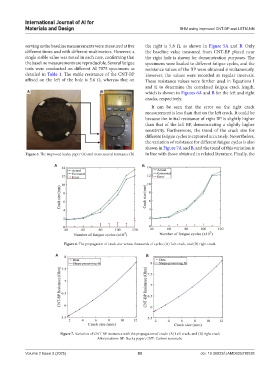
            serving as the baseline measurements were measured at five   the right is 5.8 Ω, as shown in  Figure  5A and  B. Only
            different times and with different multimeters. However, a   the baseline value measured from CNT-BP placed near
            single stable value was noted in each case, confirming that   the right hole is shown for demonstration purposes. The
            the baseline measurements are reproducible. Several fatigue   specimens were loaded to different fatigue cycles, and the
            tests were conducted on different Al 7075  specimens as   resistance values of the BP were obtained simultaneously.
            detailed in Table 1. The stable resistance of the CNT-BP   However, the values were recorded at regular intervals.
            affixed on the left of the hole is 5.6 Ω, whereas that on   These resistance values were further used in Equations I
                                                               and II to determine the correlated fatigue crack length,
             A                              B                  which is shown in Figures 6A and B for the left and right
                                                               cracks, respectively.

                                                                 It can be seen that the error on the right crack
                                                               measurement is less than that on the left crack. It could be
                                                               because the initial resistance of right BP is slightly higher
                                                               than that of the left BP, demonstrating a slightly higher
                                                               sensitivity. Furthermore, the trend of the crack size for
                                                               different fatigue cycles is captured accurately. Nevertheless,
                                                               the variation of resistance for different fatigue cycles is also
                                                               shown in Figure 7A and B, and the trend of this variation is
            Figure 5. The improved bucky paper (A) and its measured resistance (B)  in line with those obtained in related literature. Finally, the

                        A                                    B


                            Figure 6. The propagation of crack size versus thousands of cycles: (A) Left crack, and (B) right crack.

                         A                                     B


                           Figure 7. Variation of CNT-BP resistance with the propagation of crack: (A) Left crack, and (B) right crack
                                          Abbreviations: BP: Bucky paper; CNT: Carbon nanotube.


            Volume 2 Issue 3 (2025)                         83                        doi: 10.36922/IJAMD025310028

