


Page 87 - IJAMD-2-3
P. 87
International Journal of AI for
            Materials and Design                                             SHM using improved CNT-BP and LSTM-NN


              The  properties  of  CNTs are  as  follows:  density of   for structural health monitoring applications of isotropic
                                                   2
            2100  kg/cu.m, specific surface area of  200 m /g,  and   or anisotropic materials.
                           4
            conductivity  >10 S /m.   The  experimental  setup  for
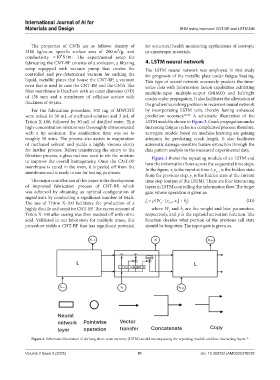
            fabricating the CNT-BP consists of a sonicator, a filtering   4. LSTM neural network
            setup equipped with vacuum pump that creates the   The LSTM neural network was employed in this study
            controlled and pre-determined vacuum for sucking the   for prognosis of the metallic plate under fatigue loading.
            liquid, metallic plates that house the CNT-BP, a vacuum   This type of neural network accurately predicts the time-
            oven that is used to cure the CNT-BP, and the CNTs. The   series data with information fusion capabilities exhibiting
            filter membrane is Deschem with an outer diameter (OD)   multiple-input  multiple-output (MIMO) and left/right
            of 150  mm and a membrane of cellulose acetate with   cracks under propagation. It also facilitates the alleviation of
            thickness of 45 µm.                                the gradient vanishing problem in recurrent neural network
              For the fabrication procedure, 300  mg of MWCNT   by incorporating LSTM unit, thereby having enhanced
            were mixed in 30 mL of methanol solution and 3 mL of   prediction  accuracy. 22-25   A  schematic  illustration  of  the
            Triton X-100, followed by 30 mL of distilled water. This   LSTM model is shown in Figure 3. Crack propagation under
            high-concentration mixture was thoroughly ultrasonicated   increasing fatigue cycles is a complicated process; therefore,
            with a tip sonicator. The sonification time was set to   surrogate models based on machine learning are gaining
            roughly 30 mins. The process also assists in evaporation   attention for predicting crack length. It also facilitates
            of methanol solvent and yields a highly viscous slurry   automatic damage-sensitive feature extraction through the
            for further process. Before transferring the slurry to the   data pattern analysis in the measured experimental data.
            filtration process, a glass rod was used to stir the mixture   Figure 3 shows the repeating module of an LSTM and
            to  improve  the  overall  homogeneity.  Once  the  CNT-BP   how the information flows across the sequential time steps.
            membrane is cured in the oven, it is peeled off from the   In the figure, x  is the input at time t, y  is the hidden state
            membrane and is ready to use for testing purposes.            t                  t−1
                                                               from the previous step, y  is the hidden state at the current
                                                                                   t
              The major contribution of this paper is the development   time step (output of the LSTM). There are four interacting
            of improved fabrication process of CNT-BP, which   layers in LSTM controlling the information flow. The forget
            was achieved by obtaining an optimal configuration of   gate, whose operation is given as:
            ingredients by conducting a significant number of trials.   f  = ρ(W  ⋅ [y , x ] + b)         (III)
            The use of Triton X-100 facilitates the production of a   t  f  t−1  t  f
            highly ductile and sensitive CNT-BP. The excess amount of   where W  and b are the weight and bias parameters,
                                                                         f
                                                                               f
            Triton X-100 after curing was then washed off with nitric   respectively, and ρ is the sigmoid activation function. The
            acid. Validated in our laboratory for multiple times, this   function decides what portion of the previous cell state
            procedure yields a CNT-BP that has significant potential   should be forgotten. The input gate is given as,


              Figure 3. Schematic illustration of the long short-term memory (LSTM) model encompassing the repeating module and four interacting layers. 26


            Volume 2 Issue 3 (2025)                         81                        doi: 10.36922/IJAMD025310028

