


Page 73 - IJB-1-1
P. 73
Mohammad Vaezi and Shoufeng Yang

            followed  by cooling to room temperature, thus miti-  evaluate presence of air bubbles within the
            gating thermal stress and cracking.                biocomposites after  moulding.  CT scanning of the
               • Dynamic Loading: Mould was heated up to 400℃   composites  was performed  with  a  225 kV  X-ray
            and maintained for 20 minutes. Load was applied for   source and Tungsten target and peak voltage was set
            5 seconds before heating was stopped, then the mould   to 120 kV with no pre-filtration.  In order to achieve
            was left to cool under pressure, until the temperature   sufficient flux, 93 µA  current was used (11.16  W).
            fell below 143℃, at which the sample was removed.      Throughout the 360 degrees rotation, 3142 projections
               A series of HA scaffolds with a range of filament   were taken, with an average of 8 frames per projection
            and pore sizes were 3D printed, and subsequently   to improve the signal to noise ratio. Exposure time of
            overmoulded using dynamic loading to investigate the   each projection was 177 ms with a gain of 30 dB. To
            effects of filament/pore size on  PEEK infiltration   reduce the effect of ring  artefacts, shuttling  was
            depth into the HA scaffold.  The effect of dwelling   applied  with  a  maximum  displacement  of  15  pixels.
            time at the target temperature on the formation of   Projection  data was reconstructed using  Nikon’s
            PEEK HA composites  was also  explored. Through    CTPro and CTAgent reconstruction software, which
            experimentation of the effect of load application dur-  uses a filtered back projection algorithm. VG Studio
            ing load and dwelling time, it was possible to optimize   Max 2.1 image processing application was used to
            infiltration of molten PEEK through the HA pores   standardize the volume (average volume of 220.14
                                                                  3
            without causing degradation of the polymer. Table 1   mm ) analysed from each sample.
            shows the details of the samples and the condition of   3. Results
            the experiments. Samples  were cut using  diamond
            cutter (Mecatome T210,  Presi, France).  Infiltration   HA scaffolds with a range of filament and pore sizes
            depth was measured with the use of the optical micro-  were printed using the bespoke developed 3D printer.
            scopy   (Olympus    BH2-UMA,     Japan).  Scan-    Through control of the printing parameters such as
            ning electron  microscope (SEM) (JEOL JSM-6500F,   solvent content, paste deposition speed, and layer
            Oxford Instruments, UK) was used for analysis of the   thickness, the microstructure of the scaffolds could be
            samples. Static loading was also  used to produce   determined.  HA filaments  were delivered  with  high
            another set of PEEK/HA composites with a range of   precision, with diameters  down  to 50  µm,  achieved
            HA scaffold filament and pore sizes as shown in Table   with  the use of customized  nozzle with  a small die
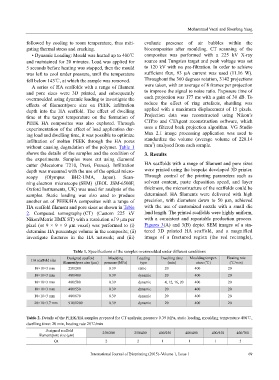
            2.  Computed tomography (CT) (Custom 225  kV       land length. The printed scaffolds were highly uniform,
            Nikon/Metris HMX ST) with a resolution of 9 µm per   with  a  consistent and repeatable production  process.
            pixel (or 9 × 9 × 9 µm voxel) was performed to (i)   Figures  3(A)  and  3(B)  depict SEM images  of a sin-
            determine HA percentage volume in the composite; (ii)   tered 3D  printed HA scaffold, and a magnified
            investigate fractures in  the HA  network; and  (iii)   image of a fractured region  (the red  rectangle),

                                Table 1. Specifications of the samples overmoulded under different conditions
                              Designed scaffold   Moulding   Loading     Dwelling time   Moulding temper-  Heating rate
              HA scaffold size
                            filament/pore size (µm)   pressure (MPa)   type   (min)   ature (℃)    (℃/min)
                10×10×3 mm    250/200           0.39        static     20           400           20
                10×10×3 mm    400/400           0.39        dynamic    20           400           20
                10×10×3 mm    400/500           0.39        dynamic    4, 12, 16, 20   400        20
                10×10×3 mm    400/550           0.39        dynamic    20           400           20
                10×10×3 mm    400/670           0.39        dynamic    20           400           20
                20×18×3.7 mm   910/1200         0.39        dynamic    20           400           20


            Table 2. Details of the PEEK/HA samples prepared for CT analysis; pressure 0.39 MPa, static loading, moulding temperature 400℃,
            dwelling time: 20 min, heating rate 20℃/min
                    Designed scaffold
                  filament/pore size (µm)    250/200      250/400    400/250    400/400    400/550    400/700
                        Qt.                   2             2         1          1           1         5


                                        International Journal of Bioprinting (2015)–Volume 1, Issue 1      69

