


Page 76 - IJB-1-1
P. 76
A novel bioactive PEEK/HA composite with controlled 3D interconnected HA network


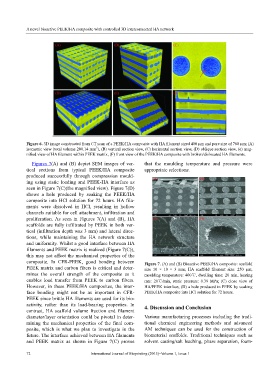
            Figure 6. 3D image constructed from CT scan of a PEEK/HA composite with HA filament sized 400 μm and pore size of 700 μm; (A)
                                          3
            isometric view (total volume 200.14 mm ), (B) vertical section view, (C) horizontal section view, (D) oblique section view, (e) mag-
            nified view of HA filament within PEEK matrix, (F) front view of the PEEK/HA composite with broken/dislocated HA filaments.
               Figures 7(A) and (B) depict SEM images of ver-  that  the moulding temperature and  pressure  were
            tical sections from typical  PEEK/HA  composite    appropriate selections.
            produced successfully through  compression  mould-
            ing  using static loading  and  PEEK-HA interface as
            seen in Figure 7(C)(the magnified view). Figure 7(D)
            shows a hole produced  by  soaking the  PEEK/HA
            composite into  HCl solution for 72 hours. HA fila-
            ments were dissolved in  HCl, resulting in  hollow
            channels suitable for cell attachment, infiltration and
            proliferation. As  seen  in  Figures  7(A)  and  (B),  HA
            scaffolds are fully infiltrated by PEEK in both ver-
            tical (infiltration depth was 3 mm) and lateral direc-
            tions, while maintaining the HA network structure
            and uniformity. Whilst a good interface between HA
            filaments and PEEK matrix is realized (Figure 7(C)),
            this may not affect the mechanical properties of the
            composite.  In CFR-PEEK, good bonding  between     Figure 7. (A) and (B) Bioactive PEEK/HA composite: scaffold
            PEEK matrix and carbon fibers is critical and deter-  size 10  ×  10  ×  3 mm;  HA scaffold filament size: 250 µm;
            mines the overall strength  of the composite as it   moulding temperature: 400℃, dwelling time: 20 min, heating
            enables load transfer from PEEK to carbon fibers.   rate: 20℃/min, static pressure:  0.39 MPa;  (C) close view of
            However,  in  these  PEEK/HA  composites,  the  inter-  HA/PEEK interface; (D) a hole produced in PEEK by soaking
            face  bonding might not be as important in  CFR-   PEEK/HA composite into HCl solution for 72 hours.
            PEEK since brittle HA filaments are used for its bio-
            activity, rather than  its load-bearing properties. In   4. Discussion and Conclusion
            contrast,  HA scaffold  volume fraction  and  filament
            diameter/layer orientation could be pivotal in deter-  Various manufacturing processes including the tradi-
            mining the mechanical  properties of the final  com-  tional  chemical  engineering  methods  and  advanced
            posite,  which is what we  plan  to investigate in  the   AM techniques  can be used for the construction of
            future. The interface achieved between HA filaments   biomaterial scaffolds. Traditional techniques such as
            and  PEEK matrix as shown in  Figure  7(C)  proves   solvent casting/salt leaching, phase separation, foam-

            72                          International Journal of Bioprinting (2015)–Volume 1, Issue 1

