


Page 75 - IJB-1-1
P. 75
Mohammad Vaezi and Shoufeng Yang

            moulded at 12–15 MPa and 350℃–375℃. The use of     folds with a range of filament and pore sizes through
            injection pressures of 11–14 MPa and temperature of   conditions presented in Table 1. Infiltration depth was
            395℃was  previously  used  in  the  injection  moulding   shown to be proportional to the pore size so that the
                                  [4]
            of PEEK/HA compounds . Through experimentation,    scaffold, with dimensions of 20 × 18 × 3.7 mm, and
            the optimal pressure to  ensure full infiltration  of a   filaments sized 910 μm while pores are 1200 μm, was
            scaffold at size 10 × 10 × 3 mm without resulting in   found to be fully infiltrated by PEEK in both lateral
            damage, was determined to be in the region of 0.39   and  vertical directions,  and  HA network  retained  its
            MPa. The optimal pressure used in this study is simi-  structure and shape.  For  similar  sized  scaffolds that
            lar to that used by other researchers in the compres-  are 400 µm in filament size but of differing pore sizes
            sion moulding of reinforced carbon fibre-PEEK com-  (400, 500, 550 and 670 µm), the respective infiltration
            posites [30–32] .  Luo  et al. [30]   tested  pressures ranging   depths are as follows: 1.4, 1.9, 2.4 and 2.9 mm. When
            from 0.5 to 2.0 MPa and found that 0.5 MPa is the   the infiltration  depths—using dynamic loading—are
            most suitable pressure for making 3D carbon-fibre   compared with the infiltration as seen following static
            reinforced  PEEK  (CFR-PEEK) composites prepared   loading, it can  be  concluded  even in  scaffolds  with
            by 3D co-braiding and compression moulding tech-   pores of 200 μm that dynamic loading of the molten
            niques. Mrse and Piggott [32]  employed 0.4 MPa pres-  PEEK does not permit sufficient time for flow through
            sure for the preparation of AS-4  CFR-PEEK using   the scaffold. Infiltration depth was found to be more
            lay-up followed by compression moulding process to   dependent on the temporal application of pressure
            avoid fibre damage. CT analysis was used to visualize   than the absolute magnitude of the pressure.  Thus,
            the  PEEK/HA composite and  to  detect over-       different pore sizes ranging from 200 µm to 700 µm
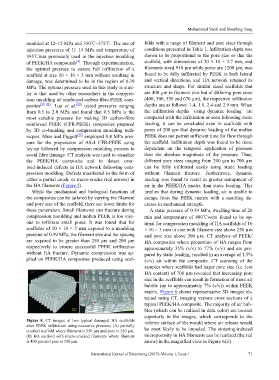
            load-induced  defects  in  HA  network  following  com-  can  be fully infiltrated  easily using  static loading
            pression moulding. Defects manifested in the form of   without filament fracture. Furthermore, dynamic
            either a partial crush, or micro-cracks (red arrows) in   loading was found to result in greater entrapment of
            the HA filaments (Figure 5).                       air in  the PEEK/HA matrix  than  static loading.  This
               While the mechanical and  biological functions  of   implies that during dynamic loading, air is unable to
            the composites can be tailored by varying the filament   escape from the  PEEK matrix  with  a resulting  de-
            and pore size of the scaffold, there are lower limits for   crease in mechanical strength.
            these parameters. Small filaments can fracture during   A static pressure of 0.39 MPa, dwelling time of 20
            compression moulding and molten PEEK is too visc-  min and temperature of 400℃were found to be op-
            ous to infiltrate small pores. It was found that for   timal for compression moulding of HA scaffolds of 10
            scaffolds of 10 × 10 × 3 mm exposed to a moulding   × 10 × 3 mm in size with filament size above 250 µm
            pressure of 0.39 MPa, the filament size and the spacing   and pore size above 200 µm. CT analysis of PEEK/
            are required  to  be greater than  250  μm and 200  μm     HA composites where proportion of HA ranges from
            respectively to ensure  successful  PEEK infiltration   approximately 35%  (v/v)  to 77%  (v/v) and  are  pre-
            without HA fracture.  Dynamic compression was ap-  pared by static loading, resulted in an average of 1.5%
            plied on PEEK/HA composites produced using scaf-   (v/v) air  within the composite. CT scanning of the
                                                               samples where scaffolds had larger pore size (i.e. less
                                                               HA content) of 700 µm revealed that increasing pore
                                                               size in the scaffolds can result in formation of more air
                                                               bubble (up to approximately 7% (v/v)) within PEEK
                                                               matrix. Figure 6 shows representative 3D images ob-
                                                               tained using CT, imaging various cross sections of a
                                                               typical PEEK/HA composite. The majority of air bub-
                                                               bles (which can be realized in dark color) are located
                                                               superiorly in the images,  which corresponds to the
            Figure 5.  CT images of two typical damaged HA scaffolds   inferior surface of the mould where air release would
            after PEEK infiltration using excessive pressure; (A) partially
            crushed scaffold where filament is 250 µm and pore is 250 µm,   be most likely  to be impeded. The sintering-induced
            (B) HA scaffold with micro-cracked filaments where filament   microporosity in HA filaments can be realized (the red
            is 400 µm and pore is 550 µm.                      arrow) in the magnified view in Figure 6(E).

                                        International Journal of Bioprinting (2015)–Volume 1, Issue 1      71

