


Page 74 - IJB-1-1
P. 74
A novel bioactive PEEK/HA composite with controlled 3D interconnected HA network

            respectively. As seen in Figure 3(B), pores within the   result  in  inadequate  melting  of  PEEK  and  therefore,
            range of 1–5 µm in both fractured surface and external   failure to  perfuse the scaffold  pores at low pressure.
            surfaces of the filament were realized through sinter-  Dwelling  time  must be sufficient to  permit adequate
            ing. The rough surface of HA filaments has the poten-  heat transfer throughout the powder, including powder
            tial to  promote  osteointegration  in  vivo.  The  main   residing at a distance from the heat source. Conversely,
            advantage of solvent-based  extrusion freeforming is   prolonged time at the target temperature will result in
            that both macroporosity of scaffold or spacing (yellow   thermal oxidation and degradation of the polymer.
            areas in Figure 3(A)) and microporosity of filaments   Samples with 400 µm filament and 500 µm pore sizes
            (in  Figure 3(B)) are controllable. Macroporosity was   were overmoulded using dwelling times of 4, 12, 16,
            controlled via computer design, and microporosity via   and 20 minutes, under dynamic loading  (details in
            alternation in sintering temperature and dwelling time.   Table 1). Four minutes dwelling time was insufficient
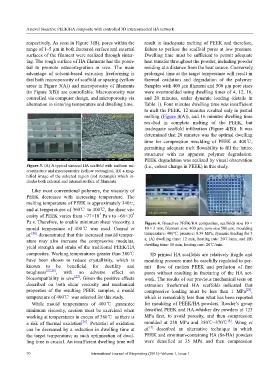
                                                               to melt the PEEK, 12 minutes resulted only in partial
                                                               melting (Figure 4(A)), and 16 minutes dwelling time
                                                                 b
                                                               resulted in complete  melting of the  PEEK, but
                                                               inadequate scaffold infiltration (Figure 4(B)).  It  was

                                                               determined that 20 minutes was the optimal dwelling
                                                               time for compression  moulding of PEEK at 400℃,
                                                               permitting adequate melt flowability to fill the lattice
                                                               structures with no  apparent  polymer  degradation.
                                                               PEEK degradation was realized by visual observation
            Figure 3. (A) A typical sintered HA scaffold with uniform mi-  (i.e., colour change in PEEK) in this study.
            crostructure and macroporosity (yellow rectangles), (B) a mag-
            nified image of the selected region (red  rectangle) which in-
            cludes both external and internal surface of filaments.

               Like most conventional polymers, the viscosity of
            PEEK decreases with  increasing  temperature.  The
            melting temperature of PEEK is approximately 340℃,
            and at temperatures of 360℃  to 400℃, the shear vis-
                                           3
                                                          3
            cosity of PEEK varies from ~77×10  Pa∙s to ~66×10
            Pa∙s. Therefore, to enable minimum shear viscosity, a   Figure 4. Bioactive PEEK/HA composites, scaffolds size 10 ×
            mould temperature of 400℃  was used.  Conrad  et   10 × 3 mm, filament size: 400 µm, pore size 500 µm, moulding
            al. [26]  demonstrated that this increased mould temper-  temperature: 400ºC, pressure: 0.39 MPa, dynamic loading for 5
            ature may also  increase the compressive  modulus,   s; (A) dwelling time: 12 min, heating rate: 20℃/min, and (B)
            yield strength and strain of the traditional PEEK/HA   dwelling time: 16 min, heating rate: 20℃/min.
            composites. Working temperatures greater than 380℃   3D printed HA scaffolds are relatively fragile and
            have  been shown  to  reduce  crystallinity, which  is   moulding pressure must be carefully regulated to per-
            known    to  be   beneficial  for  ductility  and  mit  flow of  molten PEEK and perfusion of fine
            toughness [27,28] ,  with  no  adverse  effect  on  pores without resulting in fracturing of the HA net-
            biocompatibility in vivo [27] . Given the positive effects   work. The results of our previous mechanical tests on
            described  on  both  shear viscosity and  mechanical   extrusion  freeformed  HA scaffolds indicated  that

            properties of the resulting  PEEK samples, a mould   compressive loading  must  be  less  than 1  MPa [29] ,
            temperature of 400℃  was selected for this study.   which is remarkably less than what has been reported
               While mould temperatures of 400℃  guarantee     for moulding of PEEK/HA powders. Roeder’s group
            minimum  viscosity,  caution  must  be  exercised when   densified PEEK and HA-whisker dry powders at 125
            working at temperatures in excess of 380℃  as there is   MPa first, to avoid porosity, and then compression
                                                                                                  [8]
            a risk of thermal oxidation [26] . Potential of oxidation   moulded at 250 MPa  and  350℃–370℃ .  Wong  et
                                                                 [5]
            can  be decreased  by a reduction  in  dwelling  time at   al.   described  an  alternative technique in  which
            the target temperature; as such optimisation of dwel-  PEEK and strontium-containing HA (Sr-HA) powders
            ling time is crucial. An insufficient dwelling time will   were densified  at  35 MPa and then compression

            70                          International Journal of Bioprinting (2015)–Volume 1, Issue 1

