


Page 456 - IJB-10-2
P. 456
International Journal of Bioprinting                       3D-printed bioceramic scaffolds for bone regeneration


            Therefore, HE-stained images are suitable for evaluating   lengths  were  ~538  ±  39  µm  from  the  side  (Table S1  in
            the  orientation of  collagen  fibers in  tissues.  A  10-fold   Supplementary File). The thickness of the struts was ~325
            magnified HE-stained image was obtained for evaluation   ± 17 µm (Table S1 in Supplementary File). Pores of less
            using a BZ-X digital analyzer. At least three areas were   than 2 µm in diameter in the short direction were observed
            selected for the analysis. ROIs which were squares of   between the crystals in the high-magnification SEM images
            approximately 100 µm side were manually created. At   of the struts (Figure 1G–I).
            least 50 ROIs were analyzed in each group during each   The XRD patterns revealed that the diffraction patterns
            observation period. FibrilTool provided the orientation   of the L-, S-, and LS-grafts coincided with those of CAp
            angles and anisotropy scores of the new bone within the   (Figure 2A). 33,34  In the FTIR spectra of the L-, S-, and LS-
            ROI. The reference angles were determined using the   grafts and CAp, phosphate absorption bands were observed
            same method employed for measuring the blood vessel   at 566–605 and 959–1128 cm  (Figure 2B). The doublet
                                                                                       –1
            angles. The degree of anisotropy was represented by the   carbonate absorption bands were observed at 1477 and
            length of the lines, quantified using values ranging from   1416 cm  in the carbonate ν3 region and were due to the
                                                                      –1
            0 (indicating no order) to 1 (indicating perfect order), and   presence of carbonates of A- and B-type, respectively. 33,34
            calculated using FibrilTool.                       The XRD and FTIR results indicate that the L-, S-, and LS-
            2.6. Statistical analyses                          grafts were composed of AB-type CAp.
            All  analyses  were  conducted  using  EZR,  version  1.61   The macro-porosities of the L-, S-, and LS-grafts
            (Saitama Medical Center, Jichi Medical University,   were 30.7, 31.8, and 36.6%, respectively (Table S1 in
            Saitama, Japan), which is a graphical user interface for R   Supplementary File). The total porosities of the L-, S-, and
            version 4.2.0.  One-way analyses of variance (ANOVA)   LS-grafts were 53.6, 53.9, and 59.1%, respectively (Table S1
                       32
            and Tukey’s test were used for statistical analyses, and a   in Supplementary File). The average compressive strengths
            significance level of p < 0.05 was employed to determine   of L- and S-grafts parallel and perpendicular to the pore
            the statistical significance.                      direction were 26 and 13 MPa, respectively (Figure S2 and
                                                               Table S1 in Supplementary File). The average compressive
            3. Results and discussion                          strength of the LS-graft was 8 MPa (Figure S2 and Table

            3.1. Fabrication and characterization of L-, S-, and   S1  in Supplementary File). Thus, the total porosity and
            LS-grafts                                          compressive strength of L-grafts were similar to those of
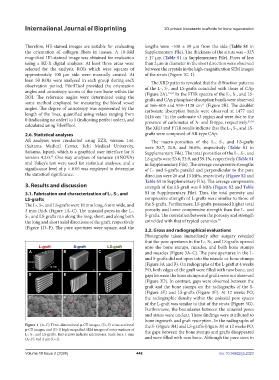
            The L-, S-, and LS-grafts were 10 mm long, 6 mm wide, and   the S-grafts. Furthermore, LS-grafts possessed higher total
            3 mm thick (Figure 1A–C). The uniaxial pores in the L-,   porosity and lower compressive strength than the L- and
            S-, and LS-grafts run along the long, short, and along both   S-grafts. The correlation between the porosity and strength
            the long and short axial directions of the graft, respectively   coincided with that of typical ceramics. 35
            (Figure 1D–F). The pore apertures were square, and the
                                                               3.2. Gross and radiographical evaluations
                                                               Photographs taken immediately after surgery revealed
                                                               that the pore apertures in the L-, S-, and LS-grafts opened
                                                               onto  the  bone  stumps,  muscles,  and  both  bone stumps
                                                               and muscles (Figure 3A–C). The pore apertures in the L-
                                                               and S-grafts did not open into the muscle or bone stumps
                                                               (Figure 3A and B). On radiographs of the L-graft at 4 weeks
                                                               PO, both edges of the graft were filled with new bone, and
                                                               gaps between the bone stumps and grafts were not observed
                                                               (Figure 3D). In contrast, gaps were observed between the
                                                               graft and the bone stumps on the radiographs of the S-
                                                               (Figure  3E)  and  LS-grafts  (Figure  3F).  At  12  weeks  PO,
                                                               the radiographic density within the uniaxial pore spaces
                                                               of the L-graft was similar to that of the struts (Figure 3G).
                                                               Furthermore, the boundaries between the uniaxial pores
                                                               and struts were unclear. These findings were attributed to
                                                               bone ingrowth and graft resorption. In the radiographs of
            Figure 1. (A–C) Three-dimensional µ-CT images, (D–F) cross-sectional   the S- (Figure 3H) and LS-grafts (Figure 3I) at 12 weeks PO,
            µ-CT images, and (G–I) high-magnified SEM images of outer surfaces of   the gaps between the bone stumps and grafts disappeared
            L-, S-, and LS-grafts. Red arrows indicate micropores. Scale bars: 1 mm
            (A–F), and 2 µm (G–I).                             and were filled with new bone. Although the pore sizes in


            Volume 10 Issue 2 (2024)                       448                                doi: 10.36922/ijb.2323

