


Page 457 - IJB-10-2
P. 457
International Journal of Bioprinting                       3D-printed bioceramic scaffolds for bone regeneration


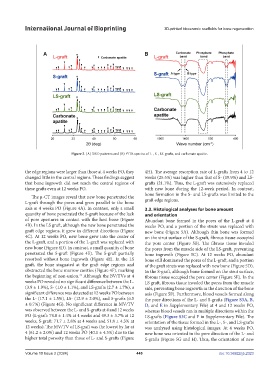
                               Figure 2. (A) XRD patterns and (B) FTIR spectra of L-, S-, LS-grafts, and carbonate apatite.


            the edge regions were larger than those at 4 weeks PO, they   4H). The average resorption rate of L-grafts from 4 to 12
            changed little in the central regions. These findings suggest   weeks (25.5%) was higher than that of S- (19.9%) and LS-
            that  bone  ingrowth  did  not  reach  the  central  regions  of   grafts (21.1%). Thus, the L-graft was extensively replaced
            these grafts even at 12 weeks PO.                  with new bone during the 12-week period. In contrast,
                                                               bone formation in the S- and LS-grafts was limited to the
               The µ-CT images reveal that new bone penetrated the
            L-graft through the pores and grew parallel to the bone   graft edge regions.
            axis at 4 weeks PO (Figure 4A). In contrast, only a small   3.3. Histological analyses for bone amount
            quantity of bone penetrated the S-graft because of the lack   and orientation
            of pore apertures in contact with the host bone (Figure   Abundant bone formed in the pores of the L-graft at 4
            4B). In the LS graft, although the new bone penetrated the   weeks PO, and a portion of the struts was replaced with
            graft edge regions, it grew in different directions (Figure   new bone (Figure 5A). Although thin bone was formed
            4C). At 12 weeks PO, new bone grew into the center of   on the strut surface of the S-graft, fibrous tissue occupied
            the L-graft, and a portion of the L-graft was replaced with   the  pore  center (Figure  5B).  The  fibrous  tissue  invaded
            new bone (Figure 4D). In contrast, a small quantity of bone   the pores from the muscle side of the LS-graft, preventing
            penetrated the S-graft (Figure 4E). The S-graft partially   bone ingrowth (Figure 5C). At 12 weeks PO, abundant
            resorbed  without bone ingrowth (Figure  4E).  In the  LS   bone still dominated the pores of the L-graft, and a portion
            graft, the bone stagnated at the graft edge regions and   of the graft struts was replaced with new bone (Figure 5D).
            obstructed the bone marrow cavities (Figure 4F), marking   In the S-graft, although bone formed on the strut surface,
            the beginning of non-union.  Although the BV/TVs at 4   fibrous tissue occupied the pore center (Figure 5E). In the
                                   35
            weeks PO revealed no significant difference between the L-   LS graft, fibrous tissue invaded the pores from the muscle
            (3.9 ± 1.9%), S- (1.0 ± 1.1%), and LS-grafts (2.7 ± 1.7%), a   side, preventing bone ingrowth in the direction of the bone
            significant difference was detected at 12 weeks PO between   axis (Figure 5F). Furthermore, blood vessels formed along
            the L- (17.1 ± 1.5%), LS- (12.9 ± 2.0%), and S-grafts (6.5   the pore directions of the L- and S-grafts (Figure S3A, B,
            ± 0.7%) (Figure 4G). No significant difference in MV/TV   D, and E in Supplementary File) at 4 and 12 weeks PO,
            was observed between the L- and S-grafts at 4 and 12 weeks   whereas blood vessels ran in multiple directions within the
            PO (L-graft: 74.8 ± 1.4% at 4 weeks and 49.3 ± 3.7% at 12   LS-grafts (Figure S3C and F in Supplementary File). The
            weeks, S-graft: 71.7 ± 2.8% at 4 weeks and 51.8 ± 4.3% at   orientation of the tissue formed in the L-, S-, and LS-grafts
            12 weeks). The MV/TV of LS-graft was the lowest by far at   was analyzed using histological images. At 4 weeks PO,
            4 (61.2 ± 2.0%) and 12 weeks PO (40.1 ± 4.3%) due to the   new bone was oriented in the pore direction of the L- and
            higher total porosity than those of L- and S-grafts (Figure   S-grafts (Figure 5G and H). Thus, the orientation of new


            Volume 10 Issue 2 (2024)                       449                                doi: 10.36922/ijb.2323

