


Page 458 - IJB-10-2
P. 458
International Journal of Bioprinting                       3D-printed bioceramic scaffolds for bone regeneration


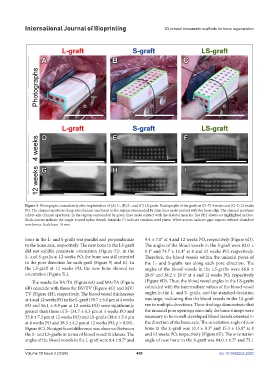
            Figure 3. Photographs immediately after implantation of (A) L-, (B) S-, and (C) LS-grafts. Radiographs of the grafts at (D–F) 4 weeks and (G–I) 12 weeks
            PO. The channel apertures (long-axis channel apertures) in the regions surrounded by cyan lines make contact with the bone edge. The channel apertures
            (short-axis channel apertures) in the regions surrounded by green lines make contact with the skeletal muscles. The PET sheets are highlighted in blue.
            Black arrows indicate the single-looped nylon thread. Asterisks (*) indicate stainless-steel plates. White arrows indicate gaps regions without abundant
            new bones. Scale bars: 10 mm.


            bone in the L- and S-grafts was parallel and perpendicular   9.4 ± 7.0° at 4 and 12 weeks PO, respectively (Figure 6D).
            to the bone axis, respectively. The new bone in the LS-graft   The angles of the blood vessels in the S-graft were 82.0 ±
            did not exhibit consistent orientation (Figure 5I). In the   8.1° and 74.7 ± 11.4° at 4 and 12 weeks PO, respectively.
            L- and S-grafts at 12 weeks PO, the bone was still oriented   Therefore, the blood vessels within the uniaxial pores of
            in the pore direction for each graft (Figure 5J and K). In   the L- and S-grafts ran along each pore direction. The
            the LS-graft at 12 weeks PO, the new bone showed no   angles of the blood vessels in the LS-grafts were 46.8 ±
            orientation (Figure 5L).                           28.6° and 38.2 ± 29.1° at 4 and 12 weeks PO, respectively
               The results for BA/TA (Figure 6A) and MA/TA (Figure   (Figure 6D). Thus, the blood vessel angles in the LS-grafts
            6B) coincide with those for BV/TV (Figure 4G) and MV/  coincided with the intermediate values of the blood vessel
            TV (Figure 4H), respectively. The blood vessel thicknesses   angles in the L- and S- grafts, and the standard deviation
            at 4 and 12 weeks PO in the L-graft (59.7 ± 6.0 µm at 4 weeks   was large, indicating that the blood vessels in the LS-graft
            PO and 56.1 ± 8.9 µm at 12 weeks PO) were significantly   ran in multiple directions. These findings demonstrate that
            greater than those of S- (34.7 ± 6.3 µm at 4 weeks PO and   the uniaxial pore openings onto only the bone stumps were
            33.8 ± 7.3 µm at 12 weeks PO) and LS-grafts (38.6 ± 3.4 µm   necessary to form well-developed blood vessels oriented in
            at 4 weeks PO and 38.3 ± 4.2 µm at 12 weeks PO, p > 0.001,   the direction of the bone axis. The orientation angle of new
            Figure 6C). No significant difference was observed between   bone in the L-graft was 10.4 ± 8.3° and 15.3 ± 15.8° at 4
            the S- and LS-grafts in terms of blood vessel thickness. The   and 12 weeks PO, respectively (Figure 6E). The orientation
            angles of the blood vessels in the L-graft were 8.4 ± 8.7° and   angle of new bone in the S-graft was 84.0 ± 6.5° and 75.1

            Volume 10 Issue 2 (2024)                       450                                doi: 10.36922/ijb.2323

