


Page 460 - IJB-10-2
P. 460
International Journal of Bioprinting                       3D-printed bioceramic scaffolds for bone regeneration


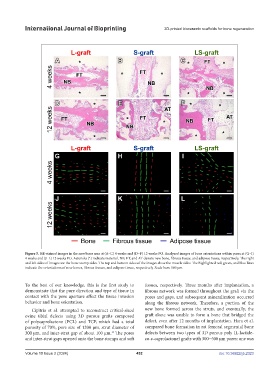
            Figure 5. HE-stained images in the new bone area at (A–C) 4 weeks and (D–F) 12 weeks PO. Analyzed images of bone orientations within pores at (G–I)
            4 weeks and (J–L) 12 weeks PO. Asterisks (*) indicate material. NB, FT, and AT denote new bone, fibrous tissue, and adipose tissue, respectively. The right
            and left sides of images are the bone stump sides. The top and bottom sides of the images show the muscle sides. The highlighted red, green, and blue lines
            indicate the orientations of new bones, fibrous tissues, and adipose tissue, respectively. Scale bars: 100 µm.


            To the best of our knowledge, this is the first study to   tissues, respectively. Three months after implantation, a
            demonstrate that the pore direction and type of tissue in   fibrous network was formed throughout the graft via the
            contact with the pore aperture affect the tissue invasion   pores and gaps, and subsequent mineralization occurred
            behavior and bone orientation.                     along the fibrous network. Therefore, a portion of the

               Cipitria et al. attempted to reconstruct critical-sized   new bone formed across the struts, and eventually, the
            ovine  tibial  defects  using  3D  porous  grafts  composed   graft alone was unable to form a bone that bridged the
            of polycaprolactone (PCL) and TCP, which had a total   defect, even after 12 months of implantation. Hara et al.
            porosity of 70%, pore size of 1200 µm, strut diameter of   compared bone formation in rat femoral segmental bone
            300 µm, and inter-strut gap of about 100 µm.  The pores   defects between two types of 3D porous poly (L-lactide-
                                                 10
            and inter-strut gaps opened onto the bone stumps and soft   co-ε-caprolactone) grafts with 300−500 μm pores: one was

            Volume 10 Issue 2 (2024)                       452                                doi: 10.36922/ijb.2323

