


Page 461 - IJB-10-2
P. 461
International Journal of Bioprinting                       3D-printed bioceramic scaffolds for bone regeneration


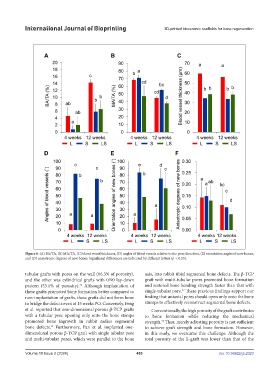
            Figure 6. (A) BA/TA, (B) MA/TA, (C) blood vessel thickness, (D) angles of blood vessels relative to the pore direction, (E) orientation angles of new bones,
            and (D) anisotropic degrees of new bones. Significant differences are indicated by different letters (p  < 0.05).


            tubular grafts with pores on the wall (66.3% of porosity),   axis, into rabbit tibial segmental bone defects. The β-TCP
            and the other was cylindrical grafts with 0/90 lay-down   graft with multi-tubular pores promoted bone formation
                                   36
            pattern (53.1% of porosity).  Although implantation of   and restored bone bending strength faster than that with
                                                                               37
            these grafts promoted bone formation better compared to   single-tubular pore.  These previous findings support our
            non-implantation of grafts, these grafts did not form bone   finding that uniaxial pores should open only onto the bone
            to bridge the defects even at 15 weeks PO. Conversely, Feng   stumps to effectively reconstruct segmental bone defects.
            et al. reported that one-dimensional porous β-TCP grafts   Conventionally, the high porosity of the graft contributes
            with a tubular pore opening only onto the bone stamps   to bone formation while reducing the mechanical
            promoted bone ingrowth in rabbit radius segmental   strength.  Thus, merely adjusting porosity is not sufficient
                                                                      38
            bone  defects.   Furthermore,  Pan et  al. implanted  one-  to achieve graft strength and bone formation. However,
                       24
            dimensional porous β-TCP graft with single tubular pore   in this study, we overcame this challenge: Although the
            and multi-tubular pores, which were parallel to the bone   total porosity of the L-graft was lower than that of the


            Volume 10 Issue 2 (2024)                       453                                doi: 10.36922/ijb.2323

