


Page 480 - IJB-10-2
P. 480
International Journal of Bioprinting                                Bioprinting with ASCs and bioactive glass


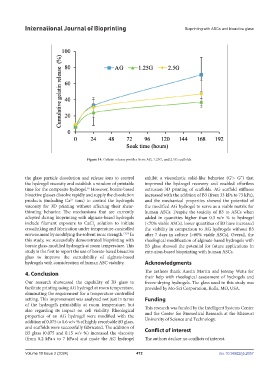
                                      Figure 14. Gelatin release profiles from AG, 1.25G, and 2.5G scaffolds.


            the glass particle dissolution and release ions to control   exhibit a viscoelastic solid-like behavior (G’> G’’) that
            the hydrogel viscosity and establish a window of printable   improved the hydrogel recovery and enabled effortless
            time for the composite hydrogel.  However, borate-based   extrusion 3D printing of scaffolds. AG scaffold stiffness
                                      55
            bioactive glasses dissolve rapidly and supply the dissolution   increased with the addition of B3 (from 33 kPa to 73 kPa),
            products (including Ca  ions) to control the hydrogels   and the mechanical properties showed the potential of
                               2+
            viscosity for 3D printing without affecting their shear-  the modified AG hydrogel to serve as a viable matrix for
            thinning  behavior. The  mechanisms that  are  currently   human ASCs. Despite the toxicity of B3 to ASCs when
            adopted during bioprinting with alginate-based hydrogels   added in quantities higher than 0.3 w/v % to hydrogel
            include filament exposure to CaCl  solution to initiate   (<70% viable ASCs), lower quantities of B3 have increased
                                         2
            crosslinking and fabrication under temperature-controlled   the viability in comparison to AG hydrogels without B3
            environment by modifying the solvent ionic strength. 13,59  In   after 7 days in culture (>80% viable ASCs). Overall, the
            this study, we successfully demonstrated bioprinting with   rheological modification of alginate-based hydrogels with
            borate glass-modified hydrogels at room temperature. This   B3 glass showed the potential for future applications in
            study is the first to report the use of borate-based bioactive   extrusion-based bioprinting with human ASCs.
            glass to improve the extrudability of alginate-based
            hydrogels with consideration of human ASC viability.  Acknowledgments

            4. Conclusion                                      The  authors  thank  Austin  Martin and  Jeremy Watts  for
                                                               their  help  with  rheological  assessment  of  hydrogels  and
            Our research showcased the capability of B3 glass to   freeze-drying hydrogels. The glass used in this study was
            facilitate printing using AG hydrogel at room temperature,   provided by Mo-Sci Corporation, Rolla, MO, USA.
            eliminating the requirement for a temperature-controlled
            setting. This improvement was analyzed not just in terms   Funding
            of  the  hydrogel’s  printability  at  room  temperature,  but   This research was funded by the Intelligent Systems Center
            also regarding its impact on cell viability. Rheological   and the Center for Biomedical Research at the Missouri
            properties of an AG hydrogel were modified with the   University of Science and Technology.
            addition of 0.075 to 0.6 w/v % of highly resorbable B3 glass,
            and scaffolds were successfully fabricated. The addition of   Conflict of interest
            B3 glass (0.075 and  0.15 w/v %) increased the  viscosity
            (from  0.2  kPa·s  to  7  kPa·s)  and  made  the  AG  hydrogel   The authors declare no conflicts of interest.


            Volume 10 Issue 2 (2024)                       472                                doi. 10.36922/ijb.2057

