


Page 476 - IJB-10-2
P. 476
International Journal of Bioprinting                                Bioprinting with ASCs and bioactive glass


            after 14 days in culture to handle and perform biological   mL) could be toxic to ASCs, whereas low concentrations
            assays. In general, hydrogel degradation depends on the   alter ASC protein secretions that may regulate wound
            soaking media composition and enzymes present in it. In   healing. Several studies have investigated the toxicity of
            our study, DI water was utilized to prepare all hydrogels and   silicate-based bioactive glasses toward stem cells in a 2D
            to investigate the scaffold swelling characteristics, which   environment, reporting that an optimum concentration
            are different from other studies where PBS or DMEM was   of ionic dissolution products could exist upon which the
            utilized. Nevertheless, samples used for mechanical tests   treatment that could be toxic to cells was administered. 44-46
            were stored in DMEM to mimic the in vitro environment.   To establish a baseline, we first investigated the B3 glass
            In addition, we also investigated the structural integrity of   toxicity to ASCs in 3D environment by adding glass in
            2.5G scaffolds in the CCM at culture conditions without   different weight percentages to AG hydrogel. First, ASCs
            crosslinking with CaCl  solution. This test was performed   were  encapsulated  in  AG,  1.25G,  2.5G,  5G, and  10G
                              2
            to examine if the divalent cations (Ca  and Mg ) that are   hydrogels, and 3D-bioprinted as spheroids. To investigate
                                                  2+
                                          2+
            released from B3 glass into the hydrogel, which helps initiate   the cell viability, spheroids were cultured in both static
            the hydrogel crosslinking, would be sufficient to sustain the   (6-well  plates under  standard culture  conditions)  and
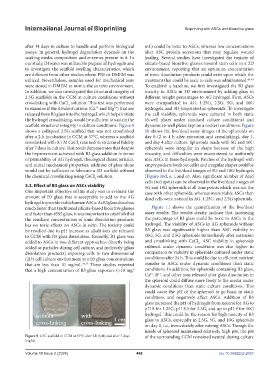
            scaffold structural integrity in culture conditions. Figure 9   dynamic (6-well plates kept on a rocker) conditions. Figure
            shows a collapsed 2.5G scaffold that was not crosslinked   10 shows the live/dead assay images of the spheroids on
            after a 2-h incubation in CCM at 37°C, whereas a scaffold   day 0 (2 to 4 h after extrusion and crosslinking), day 1,
            crosslinked with 0.1 M CaCl  retained its structural fidelity   and day 4 after culture. Spheroids made with 5G and 10G
                                  2
            after 7 days in culture. This result demonstrates that despite   spheroids were irregular in shape because of the high
            the improvement achieved with B3 glass addition in terms   viscosity, and difficulties were encountered to uniformly
            of printability of AG hydrogel, rheological characteristics,   mix ASCs in these hydrogels. Patches of the hydrogel with
            and initial mechanical properties, addition of glass alone   empty pockets (without cells) and irregular shapes could be
            would not be sufficient to fabricate a 3D scaffold without   observed in the live/dead images of 5G and 10G hydrogels
            the chemical crosslinking using CaCl  solution.    (Figure 10d, e, i, and n). Also, significant number of dead
                                         2
                                                               cells (red spots) can be observed in the live/dead images of
            3.3. Effect of B3 glass on ASCs viability          5G and 10G spheroids at all time points which was not the
            One important objective of this study was to evaluate the   case with other spheroids, whereas more viable ASCs than
            amount  of  B3  glass  that  is  acceptable  to  add  to  the  AG   dead cells were noticed in AG, 1.25G, and 2.5G spheroids.
            hydrogel to provide viable human ASCs. As B3 glass dissolves
            much faster than traditional silicate-based bioactive glasses   Figure 11 shows the quantification of the live/dead
            and faster than 45S5 glass, it was important to establish that   assay results. The results clearly indicate that increasing
            the resultant concentration of ionic dissolution products   the percentage of B3 glass could be toxic to ASCs in the
            has no toxic effects on ASCs in vitro. The toxicity could   hydrogel. The viability of ASCs in AG spheroids without
            be resulted due to pH increase as alkali ions are released   B3 glass was significantly higher than ASC viability in
            to CCM with B3 glass dissolution. Recently, B3 glass was   10G, 5G, and 2.5G spheroids immediately after extrusion
            added to ASCs in two different approaches: directly being   and crosslinking with CaCl . ASC viability in spheroids
                                                                                      2
            added as particles during cell culture, and indirectly (glass   cultured under dynamic conditions was also higher in
            dissolution products) exposing cells to two-dimensional   comparison to viability in spheroids cultured under static
            (2D) cell culture environment at a B3 glass concentrations   conditions after 24 h. This could be due to efficient nutrient
            that are less than 10 mg/mL. 30,35  These studies reported   transfer to ASCs under dynamic conditions than static
            that a high concentration of B3 glass exposure (>10 mg/  conditions. In addition, for spheroids containing B3 glass,
                                                               Ca , B , and other ions released after glass dissolution in
                                                                 2+
                                                                    3+
                                                               the spheroid could diffuse more freely to the media under
                                                               dynamic conditions than static culture conditions. This
                                                               could cause the pH of the spheroid to go basic in static
                                                               conditions and negatively affect ASCs. Addition of B3
                                                               glass increased the pH of hydrogels from neutral for AG to
                                                               pH 8 for 1.25G, pH 8.5 for 2.5G, and up to pH 9 for 10G
                                                               hydrogel. This could be the reason for high toxicity of B3
                                                               glass to ASCs, especially in 2.5G, 5G, and 10G spheroids
                                                               on day 0, i.e., immediately after mixing ASCs. Though the
                                                               inside of spheroid maintained relatively high pH, the pH
            Figure 9. 2.5G scaffold in CCM at 37°C after 2 h (left) and after 7 days   of the surrounding CCM remained neutral during culture
            (right).

            Volume 10 Issue 2 (2024)                       468                                doi. 10.36922/ijb.2057

