


Page 472 - IJB-10-2
P. 472
International Journal of Bioprinting                                Bioprinting with ASCs and bioactive glass


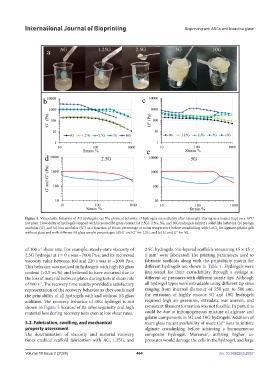
            Figure 4. Viscoelastic behavior of AG hydrogels. (a) The physical behavior of hydrogels immediately after overnight stirring in a beaker kept on a 40°C
            hot plate. Flowability of hydrogels stopped with increased B3 glass content (at 2.5G). 2.5G, 5G, and 10G hydrogels exhibit a solid-like behavior. (b) Storage
            modulus (G’) and (c) loss modulus (G’’) as a function of Strain percentage at room temperature before crosslinking with CaCl  for alginate-gelatin gels
                                                                                             2
            without glass and with different B3 glass weight percentages. (d) G’ and G’’ for 2.5G, and (e) G’ and G’’ for 5G.

            of 100 s  shear rate. For example, steady-state viscosity of   2.5G hydrogels. Six-layered scaffolds measuring 15 × 15 ×
                  -1
            2.5G hydrogel at t = 0 s was ~7000 Pa·s, and its recovered   1 mm  were fabricated. The printing parameters used to
                                                                    3
            viscosity value between 160 and 220 s was at ~2000 Pa·s.   fabricate scaffolds along with the printability matrix for
            This behavior was noticed in hydrogels with high B3 glass   different hydrogels are shown in Table 1. Hydrogels were
            content (>2.5 wt.%) and believed to have occurred due to   first tested for their extrudability through a syringe at
            the loss of material between plates during tests at shear rate   different air pressures with different nozzle tips. Although
            of 100 s . The recovery time results provided a satisfactory   all hydrogel types were extrudable using different tip sizes
                  -1
            representation of the recovery behavior as they confirmed   ranging from internal diameter of 250 µm to 580 µm,
            the printability of all hydrogels with and without B3 glass   the extrusion of highly viscous 5G and 10G hydrogels
            addition. The recovery behavior of 10G hydrogel is not   required high air pressures, extrudate was uneven, and
            shown in Figure 5 because of its inhomogeneity and high   consistent filament formation was not feasible. In part, this
            material loss during recovery tests even at low shear rates.  could be due to inhomogeneous mixture of alginate and
                                                               gelatin components in 5G and 10G hydrogels. Addition of
            3.2. Fabrication, swelling, and mechanical         more glass meant availability of more Ca  ions to initiate
                                                                                                2+
            property assessment                                alginate  crosslinking  before  achieving  a  homogeneous
            The determination of viscosity and material recovery   composite  hydrogel.  Moreover,  utilizing  higher  air
            times  enabled  scaffold  fabrication  with  AG,  1.25G,  and   pressures would damage the cells in the hydrogel, and large

            Volume 10 Issue 2 (2024)                       464                                doi. 10.36922/ijb.2057

