


Page 474 - IJB-10-2
P. 474
International Journal of Bioprinting                                Bioprinting with ASCs and bioactive glass


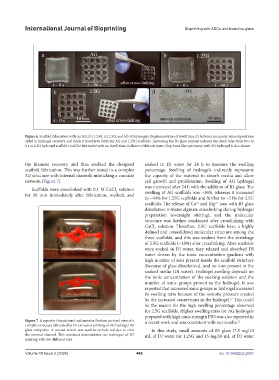
            Figure 6. Scaffold fabrication with (a) AG, (b) 1.25G, (c) 2.5G, and (d) 5G hydrogels. Implementation of dwell time (t) between successive layer depositions
            aided in hydrogel recovery and made it feasible to fabricate AG and 1.25G scaffolds. Increasing the B3 glass content reduced the dwell time from 90 s to
            0 s as 2.5G hydrogel scaffold could be fabricated with no dwell time. Failure to fabricate parts (dog-bone like specimen) with 5G hydrogel is also shown.


            the filament recovery and thus enabled the  designed   soaked in DI water for 24 h to measure the swelling
            scaffold fabrication. This was further tested in a complex   percentage. Swelling of hydrogels indirectly represents
            3D structure with internal channels mimicking a vascular   the capacity of the material to absorb media and allow
            network (Figure 7).                                cell growth and proliferation. Swelling of AG hydrogel
                                                               was increased after 24 h with the addition of B3 glass. The
               Scaffolds were crosslinked with 0.1 M CaCl  solution
                                                  2
            for  10  min  immediately  after  fabrication,  washed,  and   swelling of AG scaffolds was ~36%, whereas it increased
                                                               to ~44% for 1.25G scaffolds and further to ~51% for 2.5G
                                                               scaffolds. The release of Ca  and Mg  ions with B3 glass
                                                                                             2+
                                                                                     2+
                                                               dissolution initiates alginate crosslinking during hydrogel
                                                               preparation (overnight stirring), and the molecular
                                                               structure was further condensed after crosslinking with
                                                               CaCl  solution. Therefore, 2.5G scaffolds have a highly
                                                                   2
                                                               defined and consolidated molecular structure among the
                                                               three scaffolds, and this was evident from the shrinkage
                                                               of 2.5G scaffolds (~18%) after crosslinking. After scaffolds
                                                               were soaked in DI water, they relaxed and absorbed DI
                                                               water  driven  by  the  ionic  concentration  gradient  with
                                                               high number of ions present inside the scaffold structure
                                                               (because of glass dissolution), and no ions present in the
                                                               soaked media (DI water). Hydrogel swelling depends on
                                                               the ionic concentration of the soaking solution and the
                                                               number of ionic groups present in the hydrogel. It was
                                                               reported that increased ionic groups in hydrogel increased
                                                               its swelling ratio because of the osmotic pressure created
                                                               by the increased counterions in the hydrogel.  This could
                                                                                                   37
                                                               be the reason for the high swelling percentage observed
                                                               for 2.5G scaffolds. Higher swelling ratio for AG hydrogels
                                                               prepared with high ionic strength PBS was also reported in
            Figure 7. A superior (top picture) and anterior (bottom picture) view of a   a recent work and was consistent with our results.
                                                                                                      13
            complex structure fabricated by 3D extrusion printing of AG hydrogel-B3
            glass composite. A second nozzle was used to extrude red dye to view   In this study, small amounts of B3 glass (7.5 mg/10
            the internal channel. This construct demonstrates our technique of 3D   mL of DI water for 1.25G and 15 mg/10 mL of DI water
            printing with two different inks.

            Volume 10 Issue 2 (2024)                       466                                doi. 10.36922/ijb.2057

