


Page 470 - IJB-10-2
P. 470
International Journal of Bioprinting                                Bioprinting with ASCs and bioactive glass


            and averaged for known quantity of gelatin concentration   3. Results and discussion
            to obtain a gelatin standard curve as shown in Figure 2b.
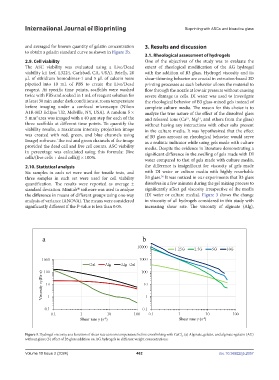
                                                               3.1. Rheological assessment of hydrogels
            2.9. Cell viability                                One of the objectives of the study was to evaluate the
            The  ASC  viability  was  evaluated  using  a  Live/Dead   extent of rheological modification of the AG hydrogel
            viability kit (ref. L3224, Carlsbad, CA, USA). Briefly, 20   with the addition of B3 glass. Hydrogel viscosity and its
            µL of ethidium homodimer-1 and 5 µL of calcein were   shear-thinning behavior are crucial in extrusion-based 3D
            pipetted into 10 mL of PBS to create the Live/Dead   printing processes as such behavior allows the material to
            reagent. At specific time points, scaffolds were washed   flow through the nozzle at low air pressure without causing
            twice with PBS and soaked in 1 mL of reagent solution for   severe damage to cells. DI water was used to investigate
            at least 30 min under dark conditions at room temperature   the rheological behavior of B3 glass-mixed gels instead of
            before imaging under a confocal microscope (Nikon   complete culture media. The reason for this choice is to
            A1R-HD Eclipse Ti2, Melville, NY, USA). A random 5 ×   analyze the true nature of the effect of the dissolved glass
            5 mm area was imaged with a 40 µm step for each of the   and released ions (Ca , Mg , and others from the glass)
                 2
                                                                                2+
                                                                                     2+
            three scaffolds at different time points. To quantify the   without having any interactions with other salts present
            viability results, a maximum intensity projection image   in the culture media. It was hypothesized that the effect
            was created with red, green, and blue channels using   of B3 glass amount on rheological behavior would serve
            ImageJ software. The red and green channels of the image   as a realistic indicator while using gels made with culture
            provided the dead cell and live cell counts. ASC viability   media. Despite the evidence in literature demonstrating a
            in  percentage  was  calculated  using  this  formula:  [live   significant difference in the swelling of gels made with DI
            cells/(live cells + dead cells)] × 100%.           water compared to that of gels made with culture media,

            2.10. Statistical analysis                         the difference is insignificant for viscosity of gels made
            Six samples in each set were used for tensile tests, and   with DI water or culture media with highly resorbable
                                                                      36
            three samples in each set were used for cell viability   B3 glass.  It was noticed in our experiments that B3 glass
            quantification. The results were reported as average ±   dissolves in a few minutes during the gel mixing process to
                                  ®
            standard deviation. Minitab  software was used to analyze   significantly affect gel viscosity irrespective of the media
            the difference in means of different groups using one-way   (DI water or culture media). Figure 3 shows the change
            analysis of variance (ANOVA). The means were considered   in viscosity of all hydrogels considered in this study with
            significantly different if the P-value is less than 0.05.  increasing shear rate. The viscosity of alginate (Alg),


            Figure 3. Hydrogel viscosity as a function of shear rate at room temperature before crosslinking with CaCl . (a) Alginate, gelatin, and alginate+gelatin (AG)
                                                                              2
            without glass; (b) effect of B3 glass addition on AG hydrogels in different weight concentrations.

            Volume 10 Issue 2 (2024)                       462                                doi. 10.36922/ijb.2057

