


Page 469 - IJB-10-2
P. 469
International Journal of Bioprinting                                Bioprinting with ASCs and bioactive glass


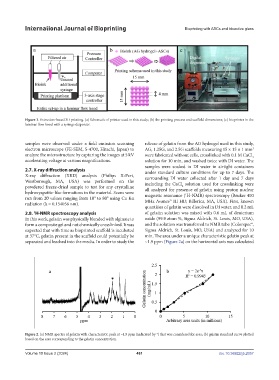
            Figure 1. Extrusion-based 3D printing. (a) Schematic of printer used in this study; (b) the printing process and scaffold dimensions; (c) bioprinter in the
            laminar flow hood with a syringe dispenser.


            samples were observed under a field emission scanning   release of gelatin from the AG hydrogel used in this study,
            electron microscope (FE-SEM, S-4700, Hitachi, Japan) to   AG, 1.25G, and 2.5G scaffolds measuring 15 × 15 × 1 mm
                                                                                                             3
            analyze the microstructure by capturing the images at 5 kV   were fabricated without cells, crosslinked with 0.1 M CaCl
                                                                                                             2
            accelerating voltage at various magnifications.    solution for 10 min, and washed twice with DI water. The
                                                               samples were soaked in DI water in airtight containers
            2.7. X-ray diffraction analysis                    under standard culture conditions for up to 7 days. The
            X-ray  diffraction  (XRD)  analysis  (Philips  X-Pert,   surrounding DI water collected after 1 day and 7 days
            Westborough, MA, USA) was performed on the         including the CaCl  solution used for crosslinking were
            powdered freeze-dried sample to test for any crystalline   all analyzed for presence of gelatin using proton nuclear
                                                                               2
            hydroxyapatite-like formations in the material. Scans were          1
            run from 2θ values ranging from 10° to 80° using Cu Kα   magnetic resonance ( H-NMR) spectroscopy (Bruker 400
                                                               MHz Avance™ III HD, Billerica, MA, USA). First, known
            radiation (λ = 0.154056 nm).
                                                               quantities of gelatin were dissolved in DI water, and 0.2 mL
               1
            2.8.  H-NMR spectroscopy analysis                  of gelatin solution was mixed with 0.6 mL of deuterium
            In this work, gelatin was physically blended with alginate to   oxide (99.9 atom %, Sigma Aldrich, St. Louis, MO, USA),
            form a composite gel and not chemically crosslinked. It was   and the solution was transferred to NMR tube (Colorspec®,
            expected that with time as bioprinted scaffold is incubated   Sigma Aldrich, St. Louis, MO, USA) and analyzed for 10
            at 37°C, gelatin present in the scaffold could potentially be   min. The area under a unique characteristic gelatin peak at
            separated and leached into the media. In order to study the   ~1.9 ppm (Figure 2a) on the horizontal axis was calculated


            Figure 2. (a) NMR spectra of gelatin with characteristic peak at ~1.9 ppm (indicated by *) that was considered for area; (b) gelatin standard curve plotted
            based on the area corresponding to the gelatin concentration.


            Volume 10 Issue 2 (2024)                       461                                doi. 10.36922/ijb.2057

