


Page 478 - IJB-10-2
P. 478
International Journal of Bioprinting                                Bioprinting with ASCs and bioactive glass


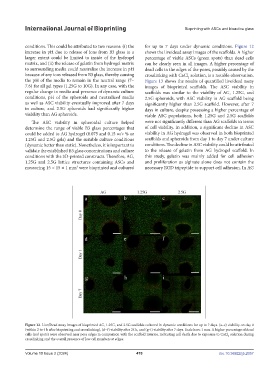
            conditions. This could be attributed to two reasons: (i) the   for up  to 7  days under  dynamic  conditions.  Figure  12
            increase in pH due to release of ions from B3 glass to a   shows the live/dead assay images of the scaffolds. A higher
            larger extent could be limited to inside of the hydrogel   percentage of  viable  ASCs  (green  spots)  than  dead  cells
            matrix, and (ii) the release of gelatin from hydrogel matrix   can be clearly seen in all images. A higher percentage of
            to surrounding media could neutralize the increase in pH   dead cells in the edges of the pores, possibly caused by the
            because of any ions released from B3 glass, thereby causing   crosslinking with CaCl  solution, is a notable observation.
                                                                                 2
            the pH of the media to remain in the neutral range (7–  Figure 13 shows the results of quantified live/dead assay
            7.6) for all gel types (1.25G to 10G). In any case, with the   images of bioprinted scaffolds. The ASC viability in
            regular change in media and presence of dynamic culture   scaffolds was similar to the viability of AG, 1.25G, and
            conditions, pH of the spheroids and neutralized media   2.5G spheroids, with ASC viability in AG scaffold being
            as well as ASC viability eventually improved after 7 days   significantly higher than 2.5G scaffold. However, after 7
            in culture, and 2.5G spheroids had significantly higher   days in culture, despite possessing a higher percentage of
            viability than AG spheroids.                       viable ASC populations, both 1.25G and 2.5G scaffolds
               The ASC viability in spheroidal culture helped   were not significantly different than AG scaffolds in terms
            determine the range of viable B3 glass percentages that   of cell viability. In addition, a significant decline in ASC
            could be added to AG hydrogel (0.075 and 0.15 w/v % or   viability in AG hydrogel was observed in both bioprinted
            1.25G and 2.5G gels) and the suitable culture conditions   scaffolds and spheroids from day 1 to day 7 under culture
            (dynamic better than static). Nonetheless, it is important to   conditions. The decline in ASC viability could be attributed
            validate the established B3 glass concentrations and culture   to the release of gelatin from AG hydrogel scaffold. In
            conditions with the 3D-printed constructs. Therefore, AG,   this  study,  gelatin  was  mainly  added  for  cell  adhesion
            1.25G and 2.5G lattice structures containing ASCs and   and proliferation as alginate alone does not contain the
                                  3
            measuring 15 × 15 × 1 mm  were bioprinted and cultured   necessary RGD tripeptide to support cell adhesion. In AG


            Figure 12. Live/Dead assay images of bioprinted AG, 1.25G, and 2.5G scaffolds cultured in dynamic conditions for up to 7 days. (a–c) viability on day 0
            (within 2 to 4 h after bioprinting and crosslinking), (d–f) viability after 24 h, and (g–i) viability after 7 days. Scale bars: 1 mm. A higher percentage of dead
            cells (red spots) were observed near pore edges in comparison with the scaffold interior, indicating cell death due to exposure to CaCl  solution during
                                                                                                  2
            crosslinking and the overall presence of low cell numbers at edges.

            Volume 10 Issue 2 (2024)                       470                                doi. 10.36922/ijb.2057

