


Page 477 - IJB-10-2
P. 477
International Journal of Bioprinting                                Bioprinting with ASCs and bioactive glass


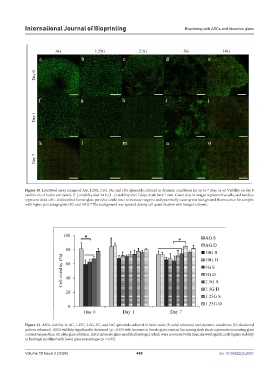
            Figure 10. Live/Dead assay images of AG, 1.25G, 2.5G, 5G, and 10G spheroids cultured in dynamic conditions for up to 7 days. (a–e) Viability on day 0
            (within 2 to 4 h after extrusion), (f–j) viability after 24 h, (k–o) viability after 7 days. Scale bars: 1 mm. Green dots in images represent live cells, and red dots
            represent dead cells. Undissolved borate glass particles could react with assay reagents and potentially cause green background fluorescence for samples
            with higher percentage glass (5G and 10G).  The background was ignored during cell quantification with ImageJ software.
                                       26


            Figure 11. ASCs viability in AG, 1.25G, 2.5G, 5G, and 10G spheroids cultured in both static (S; solid columns) and dynamic conditions (D; checkered
            pattern columns). ASCs viability significantly decreased (p < 0.05) with increase in borate glass content (increasing dark shade represents increasing glass
            content) in less than 4 h after glass addition. ASCs in borate glass-modified hydrogel, which were recovered with time, showed significantly higher viability
            in hydrogel modified with lower glass percentages (p < 0.05).


            Volume 10 Issue 2 (2024)                       469                                doi. 10.36922/ijb.2057

