


Page 479 - IJB-10-2
P. 479
International Journal of Bioprinting                                Bioprinting with ASCs and bioactive glass


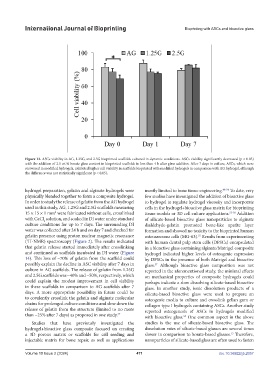
            Figure 13. ASCs viability in AG, 1.25G, and 2.5G bioprinted scaffolds cultured in dynamic conditions. ASCs viability significantly decreased (p < 0.05)
            with the addition of 2.5 wt.% borate glass content in bioprinted scaffolds in less than 4 h after glass addition. After 7 days in culture, ASCs, which were
            recovered in modified hydrogels, exhibited higher cell viability in scaffolds bioprinted with modified hydrogels in comparison with AG hydrogel, although
            the difference was not statistically significant (p < 0.05).


            hydrogel preparation, gelatin and alginate hydrogels were   mostly limited to bone tissue engineering. 48-54  To date, very
            physically blended together to form a composite hydrogel.   few studies have investigated the addition of bioactive glass
            In order to study the release of gelatin from the AG hydrogel   to hydrogel to regulate hydrogel viscosity and incorporate
            used in this study, AG, 1.25G and 2.5G scaffolds measuring   cells in the hydrogel+bioactive glass matrix for bioprinting
            15 × 15 × 1 mm  were fabricated without cells, crosslinked   tissue models or 3D cell culture applications. 55-58  Addition
                        3
            with CaCl  solution, and soaked in DI water under standard   of silicate-based bioactive glass nanoparticles to alginate
                    2
            culture conditions for up to 7 days. The surrounding DI   dialdehyde-gelatin promoted bone-like apatite layer
            water was collected after 24 h and on day 7 and checked for   formation and showed no toxicity to the bioprinted human
            gelatin presence using proton nuclear magnetic resonance   osteosarcoma cells (MG-63).  Results from experimenting
                                                                                      55
            ( H-NMR) spectroscopy (Figure 2). The results indicated   with human dental pulp stem cells (DPSCs) encapsulated
            1
            that gelatin release started immediately after crosslinking   in a bioactive glass containing alginate/Matrigel composite
            and continued as scaffolds incubated in DI water (Figure   hydrogel indicated higher levels of osteogenic expression
            14). This loss of ~70% of gelatin from the scaffold could   by DPSCs in the presence of both Matrigel and bioactive
            possibly explain the decline in ASC viability after 7 days in   glass.   Although  bioactive  glass  composition was  not
                                                                   57
            culture in AG scaffolds. The release of gelatin from 1.25G   reported in the aforementioned study, the minimal effects
            and 2.5G scaffolds was ~40% and ~50%, respectively, which   on mechanical properties of composite hydrogels could
            could explain the modest improvement in cell viability   perhaps indicate a slow dissolving silicate-based bioactive
            in these scaffolds in comparison to AG scaffolds after 7   glass. In another study, ionic dissolution products of a
            days. A more appropriate possibility in future could be   silicate-based bioactive glass were used to prepare an
            to covalently crosslink the gelatin and alginate molecular   osteogenic media to culture and crosslink gellan gum or
            chains for prolonged culture conditions and slow down the   collagen type I hydrogels containing ASCs. Another study
            release of gelatin from the structure (limited to no more   reported osteogenesis of ASCs in hydrogels modified
            than ~25% after 7 days) as proposed in one study. 47  with bioactive glass.  One common aspect in the above
                                                                               58
               Studies that have previously investigated the   studies is the use of silicate-based bioactive glass. The
            hydrogel+bioactive glass composite focused on creating   dissolution rates of silicate-based glasses are several times
            a 3D porous matrix or scaffolds for cell seeding and   slower in comparison to borate-based glasses.  Therefore,
                                                                                                    15
            injectable matrix for bone repair, as well as applications   nanoparticles of silicate-based glass are often used to fasten

            Volume 10 Issue 2 (2024)                       471                                doi. 10.36922/ijb.2057

