


Page 501 - IJB-10-2
P. 501
International Journal of Bioprinting                               Mineralization of 3D-printed PHA scaffolds


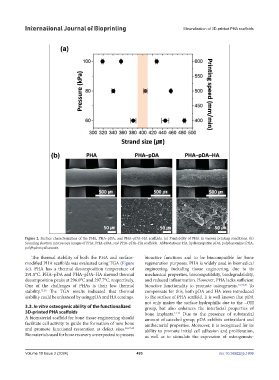
            Figure 2. Surface characterization of the PHA, PHA–pDA, and PHA–pDA–HA scaffolds. (a) Printability of PHA in various printing conditions. (b)
            Scanning electron microscopy images of PHA, PHA–pDA, and PHA–pDA–HA scaffolds.  Abbreviations: HA, hydroxyapatite; pDA, polydopamine; PHA,
            polyhydroxyalkanoate.

               The thermal stability of both the PHA and surface-  bioactive functions and to be biocompatible for bone
            modified PHA scaffolds was evaluated using TGA (Figure   regeneration purposes. PHA is widely used in biomedical
            4e). PHA has a thermal decomposition temperature of   engineering, including tissue engineering, due to its
            291.8°C. PHA–pDA and PHA–pDA–HA showed thermal     mechanical properties, biocompatibility, biodegradability,
            decomposition peaks at 296.0°C and 297.7°C, respectively.   and reduced inflammation. However, PHA lacks sufficient
            One of the challenges of PHAs is their low thermal   bioactive functionality to promote osteogenesis. 22,29,30  To
            stability. 12,26  The TGA results indicated that thermal   compensate for this, both pDA and HA were introduced
            stability could be enhanced by using pDA and HA coatings.  to the surface of PHA scaffold. It is well known that pDA
                                                               not only makes the surface hydrophilic due to the –OH
            3.3. In vitro osteogenic ability of the functionalized   group, but also enhances the interfacial properties of
            3D-printed PHA scaffolds                           bone implants. 31-33  Due to the presence of substantial
            A biomaterial scaffold for bone tissue engineering should   amount of catechol group, pDA exhibits antioxidant and
            facilitate cell activity to guide the formation of new bone   antibacterial properties. Moreover, it is recognized for its
            and promote functional restoration at defect sites. 22,27,28    ability to promote initial cell adhesion and proliferation,
            Biomaterials used for bone recovery are expected to possess   as well as to stimulate the expression of osteogenesis-


            Volume 10 Issue 2 (2024)                       493                                doi: 10.36922/ijb.1806

