


Page 502 - IJB-10-2
P. 502
International Journal of Bioprinting                               Mineralization of 3D-printed PHA scaffolds


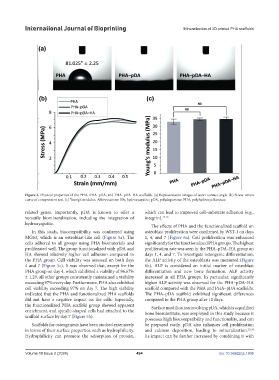
            Figure 3. Physical properties of the PHA, PHA–pDA, and PHA–pDA–HA scaffolds. (a) Representative images of water contact angle. (b) Stress–strain
            curve of compression test. (c) Young’s modulus. Abbreviations: HA, hydroxyapatite; pDA, polydopamine; PHA, polyhydroxyalkanoate.


            related genes. Importantly, pDA is known to offer a   which can lead to improved cell–substrate adhesion (e.g.,
            versatile biomineralization, including the integration of   integrin). 17,18
            hydroxyapatite.
                                                                  The effects of PHA and the functionalized scaffold on
               In this study, biocompatibility was confirmed using   osteoblast proliferation were confirmed by WST-1 on days
            MG63,  which  is  an osteoblast-like  cell  (Figure  5a).  The   1, 4, and 7 (Figure 6a). Cell proliferation was enhanced
            cells adhered to all groups using PHA biomaterials and   significantly for the functionalized PHA groups. The highest
            proliferated well. The group functionalized with pDA and   proliferation rate was seen in the PHA–pDA–HA group on
            HA showed relatively higher cell adhesion compared to   days 1, 4, and 7. To investigate osteogenic differentiation,
            the PHA group. Cell viability was assessed on both days   the ALP activity of the osteoblasts was measured (Figure
            4 and 7 (Figure 5c). It was observed that, except for the   6b). ALP is considered an initial marker of osteoblast
            PHA group on day 4, which exhibited a viability of 86.67%   differentiation  and  new  bone  formation.  ALP  activity
            ± 1.29, all other groups consistently maintained a viability   increased in all PHA groups. In particular, significantly
            exceeding 97% every day. Furthermore, PHA also exhibited   higher ALP activity was observed for the PHA–pDA–HA
            cell viability exceeding 97% on day 7. The high viability   scaffold compared with the PHA and PHA–pDA scaffolds.
            indicated that the PHA and functionalized PHA scaffolds   The PHA–pDA scaffold exhibited significant differences
            did not have a negative impact on the cells. Especially,   compared to the PHA group after 10 days.
            the functionalized PHA scaffold group showed apparent   Surface modification involving pDA, which is a qualified
            enrichment, and spindle-shaped cells had attached to the   bone biosubstitute, was employed in this study because it
            scaffold surface by day 7 (Figure 5b).             possesses high biocompatibility and functionality, and can
               Scaffolds for osteogenesis have been studied extensively   be prepared easily. pDA also enhances cell proliferation
            in terms of their surface properties, such as hydrophilicity.   and calcium deposition, leading to mineralization. 32,34
            Hydrophilicity can  promote  the  adsorption  of  protein,   Its impact can be further increased by combining it with


            Volume 10 Issue 2 (2024)                       494                                doi: 10.36922/ijb.1806

