


Page 510 - IJB-10-2
P. 510
International Journal of Bioprinting                          Oozing 3D-printed scaffolds for tissue engineering


            structures with layers of randomly distributed microfibers   two commonly manufactured controls were 3D-printed
            created by another technique (such as melt-spinning or   and fully characterized to better understand their
            electrospinning). 53,54  Although the fundamentals of this   architectural and mechanical properties together with
            methodology have been similarly reported elsewhere, 44,52    their biological potential. The algorithm-controlled 3D
            AAD-controlled random distributions remain unexplored.   random distribution of the microfibers in the oozing
            These advances point to the direction of overcoming one   specimens in cell cultures represents a novel approach
            of the fundamental architectural flaws of FDM, which is   to developing a better biomimetic scaffold to be used in
            the macroscopic geometry of the fibers and subsequent   tissue-engineering repairing strategies.
            macro-porosity of the scaffolds.
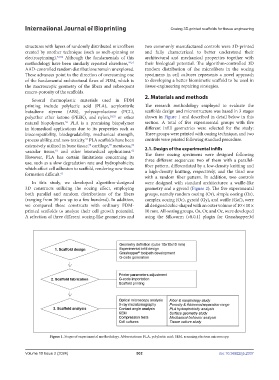
               Several thermoplastic materials used in FDM     2. Materials and methods
            printing  include  polylactic  acid  (PLA),  acrylonitrile   The  research  methodology employed to  evaluate the
            butadiene styrene (ABS), polycaprolactone (PCL),   scaffolds design and microstructure was based in 3 stages
            polyether  ether  ketone (PEEK), and nylon, 20,55  or  other   shown in Figure 1 and described in detail below in this
                             56
            natural biopolymers.  PLA is a promising biopolymer   section. A total of five experimental groups with five
            in biomedical applications due to its properties such as   different infill geometries were selected for the study:
            biocompatibility, biodegradability, mechanical strength,   Three groups were printed with oozing technique, and two
            process ability, and non-toxicity.  PLA scaffolds have been   controls were printed following standard procedure.
                                     57
            extensively utilized in bone tissue,  cartilage,  meniscus,    2.1. Design of the experimental infills
                                       58
                                                59
                                                         60
            vascular tissue,  and other biomedical applications.
                         61
                                                         62
            However, PLA has certain limitations concerning its   The three oozing specimens were designed following
            use, such as a slow degradation rate and hydrophobicity,   three different sequences: two of them with a parallel-
            which affect cell adhesion to scaffold, rendering new tissue   fiber pattern, differentiated by a low-density knitting and
            formation difficult. 61                            a high-density knitting, respectively, and the third one
                                                               with a random fiber pattern. In addition, two controls
               In this study, we developed algorithm-designed   were designed with standard architectures: a waffle-like
            3D constructs utilizing the oozing effect, employing   geometry and a gyroid (Figure 2). The five experimental
            both parallel and random distributions of the fibers   groups, namely random oozing (Or), simple oozing (Os),
            (ranging from 30 µm up to a few hundred). In addition,   complex oozing (Oc), gyroid (Gy), and waffle (Gof), were
            we compared these constructs with ordinary FDM-    all designed cubic-shaped with an outer volume of 10 × 10 ×
            printed scaffolds to analyze their cell growth potential.   10 mm. All oozing groups, Os, Or, and Oc, were developed
            A selection of three different oozing-like geometries and   using the Silkworm (v0.0.1) plugin for Grasshopper3d


                      Figure 1. Stages of experimental methodology. Abbreviations: PLA, polylactic acid; SEM, scanning electron microscopy.


            Volume 10 Issue 2 (2024)                       502                                doi: 10.36922/ijb.2337

