


Page 511 - IJB-10-2
P. 511
International Journal of Bioprinting                          Oozing 3D-printed scaffolds for tissue engineering


            (Rhinoceros). Control group (Gof) was designed with CAD   displacements of the nozzle on an  X–Y plane, and then
            software, and Gy group was designed with Ultimaker Cura   iterating different patterns at every layer of the Z axis. These
            (v4.8.0, Ultimaker) slicer. All specimens were prepared   displacements were generated and developed in Silkworm
            for 3D printing with Ultimaker Cura (v4.8.0, Ultimaker)   plugin by designing different tool paths (Figure 2C and D).
            (Figure S1 in Supplementary File).                 The Os specimen was designed by creating a grid of 8 × 8
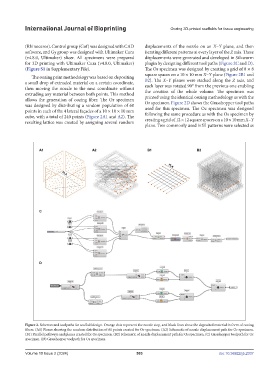
               The oozing print methodology was based on depositing   square spaces on a 10 × 10 mm X–Y plane (Figure 2B1 and
            a small drop of extruded material on a certain coordinate,   B2). The X–Y planes were stacked along the Z axis, and
            then  moving  the  nozzle  to  the  next  coordinate  without   each layer was rotated 90° from the previous one enabling
            extruding any material between both points. This method   the creation of the whole volume. The specimen was
            allows  the  generation of  oozing  fiber.  The  Or  specimen   printed using the identical oozing methodology as with the
            was designed by distributing a random population of 60   Or specimen. Figure 2D shows the Grasshopper tool paths
            points in each of the 4 lateral façades of a 10 × 10 × 10 mm   used  for  this  specimen.  The  Oc  specimen  was  designed
            cube, with a total of 240 points (Figure 2A1 and A2). The   following the same procedure as with the Os specimen by
            resulting lattice was created by assigning several random   creating a grid of 12 × 12 square spaces on a 10 × 10 mm X–Y
                                                               plane. Two commonly used infill patterns were selected as


            Figure 2. Schemes and toolpaths for scaffold design. Orange dots represent the nozzle stop, and black lines show the deposited material in form of oozing
            fibers. (A1) Planes showing the random distribution of 60 points created for Or specimen. (A2) Schematic of nozzle displacement path for Or specimen.
            (B1) Parallel pathways and planes created for Os specimen. (B2) Schematic of nozzle displacement path for Os specimen. (C) Grasshopper toolpath for Or
            specimen. (D) Grasshopper toolpath for Os specimen.


            Volume 10 Issue 2 (2024)                       503                                doi: 10.36922/ijb.2337

