


Page 517 - IJB-10-2
P. 517
International Journal of Bioprinting                          Oozing 3D-printed scaffolds for tissue engineering


                              A


                                    Day 0                    Day 1


                                    Day 2                    Day 9


                              B       100               ¶           
                                      90                              *           *
                                    Contact angle (º)  70  *  *     ¶           
                                      80

                                      60
                                      50
                                      40
                                      30
                                      20                                              Ctrl
                                                                                      NaOH
                                      10
                                       0
                                            Day 0      Day 1       Day 2      Day 9


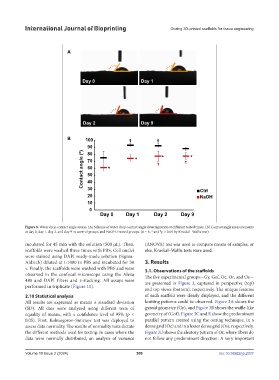
            Figure 8. Water drop contact angle assays. (A) Scheme of water drop contact angle determination at different tested times. (B) Contact angle measurements
            at day 0, day 1, day 2, and day 9 in control groups and NaOH-treated groups. (n = 6, * and  p < 0.05 by Kruskal–Wallis test)
                                                                     
            incubated for 45 min with the solution (500 µL). Then,   (ANOVA) test was used to compare means of samples, or
            scaffolds were washed three times with PBS. Cell nuclei   else, Kruskal–Wallis tests were used.
            were stained using DAPI ready-made solution (Sigma-
            Aldrich) diluted at 1:1000 in PBS and incubated for 30   3. Results
            s. Finally, the scaffolds were washed with PBS and were   3.1. Observations of the scaffolds
            observed in the confocal microscope using the Alexa   The five experimental groups—Gy, Gof, Oc, Or, and Os—
            488 and DAPI filters and z-stacking. All assays were   are presented in  Figure 3, captured in perspective (top)
            performed in triplicate (Figure 10).
                                                               and top views (bottom), respectively. The unique features
            2.10 Statistical analysis                          of each scaffold were clearly displayed, and the different
            All results are expressed as means ± standard deviation   knitting patterns could be observed. Figure 3A shows the
            (SD).  All  data  were  analyzed  using  different tests  of   gyroid geometry (Gy), and Figure 3B shows the waffle-like
            equality  of means, with a  confidence  level of 95%  (p  <   geometry of (Gof). Figure 3C and E show the predominant
            0.05). First, Kolmogorov–Smirnov test was deployed to   parallel pattern created using the oozing technique, in a
            assess data normality. The results of normality tests dictate   dense grid (Oc) and in a lesser dense grid (Os), respectively.
            the different methods used for testing: in cases where the   Figure 3D shows the aleatory pattern of Or, where fibers do
            data were normally distributed, an analysis of variance   not follow any predominant direction. A very important


            Volume 10 Issue 2 (2024)                       509                                doi: 10.36922/ijb.2337

