


Page 519 - IJB-10-2
P. 519
International Journal of Bioprinting                          Oozing 3D-printed scaffolds for tissue engineering

                      FIG.9 CELL CULTURES & CONFOCAL
                             International Journal of Bioprinting
                             http://doi.org/10.18063/ijb.XXXXXXXXXXXXX

                              A   Gy                 Gof                Oc                    E
                                                                                               Figure 9
                                                                                               Cell culture assays. (A) Representative immunofluorescence
                                                                                               images of confocal microscopy of cell culture onto the different
                                                                                               scaffolds (Gy, Gof, Oc, Or, and Os) and in control (TCP) at day 7
                                                                                               after seeding. Nucleus stained with DAPI and cytoskeleton with
                                                                                               Phalloidin. Scale bar indicates 150 um. (B) Metabolic activity at
                                                                                               days 1, 3, and 7 (n=3, p<0.05 Mann Whitney).


                                  Or                 Os                 TCP


                              B
                                     1000                              *
                                                          *
                                     900
                                     800
                                    Metabolic activity (%)  600                    Day 1
                                     700
                                     500
                                                                                   Day 3
                                     400
                                                                                   Day 7
                                     300
                                     200
                                     100                      *
                                       0
                                           Gy     Gof   Oc     Or     Os    TCP


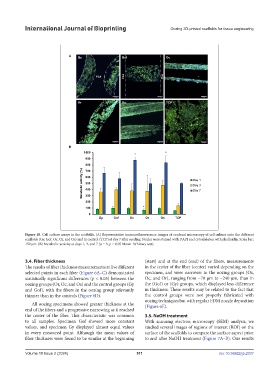
            Figure 10. Cell culture assays in the scaffolds. (A) Representative immunofluorescence images of confocal microscopy of cell culture onto the different
            scaffolds (Gy, Gof, Oc, Or, and Os) and in control (TCP) at day 7 after seeding. Nuclei were stained with DAPI and cytoskeleton with phalloidin. Scale bar:
                             Figure 10. Cell culture assays in the scaffolds. (A) Representative immunofluorescence images of
            150 µm. (B) Metabolic activity at days 1, 3, and 7 (n = 3, p < 0.05 Mann–Whitney test).
                             confocal microscopy of cell culture onto the different scaffolds (Gy, Gof, Oc, Or, and Os) and in control
                             (TCP) at day 7 after seeding. Nuclei were stained with DAPI and cytoskeleton with phalloidin. Scale bar:
            3.4. Fiber thickness                               (start) and at the end (end) of the fibers, measurements
                             150 µm. (B) Metabolic activity at days 1, 3, and 7 (n = 3, p < 0.05 Mann–Whitney test).
            The results of fiber thickness measurements at five different   in the center of the fiber (center) varied depending on the
            selected points in each fiber (Figure 6A–C) demonstrated   specimen, and were narrower in the oozing groups (Os,

            statistically significant differences (p < 0.05) between the   Oc, and Or), ranging from ~70 µm to ~240 µm, than in
            oozing groups (Or, Oc, and Os) and the control groups (Gy   the (Gof) or (Gy) groups, which displayed less difference
            and Gof), with the fibers in the oozing group relevantly   in thickness. These results may be related to the fact that


            thinner than in the controls (Figure 6D).          the  control  groups  were  not  properly  fabricated  with

               All oozing specimens showed greater thickness at the   oozing techniques but with regular FDM nozzle deposition
                                                               (Figure 6E).
            end of the fibers and a progressive narrowing as it reached
            the  center  of  the  fiber.  This  characteristic  was  common   3.5. NaOH treatment
            to all samples. Specimen Gof showed more constant   With scanning electron microscopy (SEM) analysis, we
            values,  and specimen Gy displayed almost equal values   studied several images of regions of interest (ROI) on the
            in every measured point. Although the mean values of   surface of the scaffolds to compare the surface aspect prior
            fiber thickness were found to be similar at the beginning   to and after NaOH treatment (Figure 7A–B). Our results


            Volume 10 Issue 2 (2024)                       511                                doi: 10.36922/ijb.2337

