


Page 554 - IJB-10-2
P. 554
International Journal of Bioprinting OLS design for distal femur osseointegration
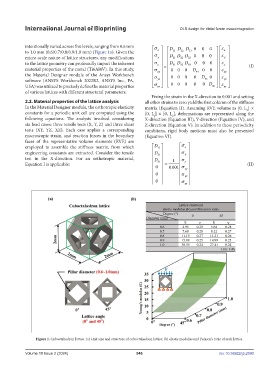
intentionally varied across five levels, ranging from 0.6 mm σ D D D 0 0 0 ε
to 1.0 mm (0.6/0.7/0.8/0.9/1.0 mm) (Figure 1a). Given the x 11 12 13 x
ε
micro-scale nature of lattice structures, any modifications σ y DD D 23 0 0 0 0 y
22
21
to the lattice geometry can profoundly impact the inherent σ z = DD D 33 0 0 0 ε z (I)
32
31
material properties of the metal (Ti6Al4V). In this study, σ xy 00 0 D 44 0 0 ε
xy
the Material Designer module of the Ansys Workbench σ 00 0 0 D 0 ε
software (ANSYS Workbench 2022R2, ANSYS Inc., PA, yz 55 yz
USA) was utilized to precisely define the material properties σ zx 00 0 0 0 D ε
66 zx
of various lattices with different structural parameters.
Fixing the strain in the X-direction to 0.001 and setting
2.2. Material properties of the lattice analysis all other strains to zero yield the first column of the stiffness
In the Material Designer module, the orthotropic elasticity matrix (Equation II). Assuming RVE volume as [0, L ] ×
x
constants for a periodic unit cell are computed using the [0, L ] × [0, L ], deformations are represented along the
z
y
following equations. The analysis involved considering X-direction (Equation III), Y-direction (Equation IV), and
six load cases: three tensile tests (X, Y, Z) and three shear Z-direction (Equation V). In addition to these periodicity
tests (XY, YZ, XZ). Each case applies a corresponding conditions, rigid body motions must also be prevented
macroscopic strain, and reaction forces in the boundary (Equation VI).
faces of the representative volume elements (RVE) are
employed to assemble the stiffness matrix, from which D σ
x
11
engineering constants are extracted. Consider the tensile D 21 σ y
test in the X-direction. For an orthotropic material, D 1 σ
Equation I is applicable: 31 = z (II)
.
0 0 001 σ xy
0 σ
yz
0 σ zx
Figure 1. Cuboctahedron lattice. (a) Unit size and structure of cuboctahedron lattice; (b) elastic modulus and Poisson’s ratio of each lattice.
Volume 10 Issue 2 (2024) 546 doi: 10.36922/ijb.2590

