


Page 559 - IJB-10-2
P. 559
International Journal of Bioprinting                              OLS design for distal femur osseointegration


            for 1 week, along with intramuscular meloxicam injection   displayed a maximum bone strain of no more than 4000
            for pain management. Post-operative CT imaging at fixed   μ (proximal layer: -3840.0 μ/distal layer: -3528.3 μ). This
            intervals (2 weeks, 4 weeks, 8 weeks, and 12 weeks) assessed   lattice structure, referred to as the OLS, demonstrated
            implant displacement or femur fractures. The animals   a remarkable ability to promote bone growth within the
            were sacrificed 12 weeks post-surgery; after being deeply   implant (Table 2).
            anesthetized, the animals were euthanized with intravenous
            KCl. After extracting femur segments, micro-CT (with a 9   3.2. Biomechanical test results of OLS implant, NLS
            µm resolution) employed for CT scan was performed for   implant, and bone cement
            assessment of the density and area of the surrounding bone.   To validate the accuracy of the analyzed values, the results
            This allowed for the evaluation of the osseointegration   of biomechanical tests were compared with those obtained
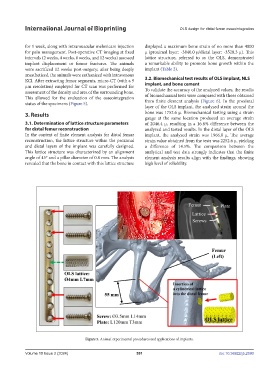
            status of the specimens (Figure 5).                from finite element analysis (Figure 6). In the proximal
                                                               layer of the OLS implant, the analyzed strain around the
            3. Results                                         bone was 1752.6 μ. Biomechanical testing using a strain
                                                               gauge at the same location produced an average strain
            3.1. Determination of lattice structure parameters   of 2046.4 μ, resulting in a 16.8% difference between the
            for distal femur reconstruction                    analyzed and tested results. In the distal layer of the OLS
            In the context of finite element analysis for distal femur   implant, the analyzed strain was 1966.8 μ. The average
            reconstruction, the lattice structure within the proximal   strain value obtained from the tests was 2252.6 μ, yielding
            and distal layers of the implant was carefully designed.   a  difference  of  14.5%.  The  comparison  between  the
            This lattice structure was characterized by an alignment   analytical and test data strongly indicates that the finite
            angle of 45° and a pillar diameter of 0.8 mm. The analysis   element analysis results align with the findings, showing
            revealed that the bone in contact with this lattice structure   high level of reliability.


                                     Figure 5. Animal experimental procedures and applications of implants.


            Volume 10 Issue 2 (2024)                       551                                doi: 10.36922/ijb.2590

