


Page 556 - IJB-10-2
P. 556
International Journal of Bioprinting                              OLS design for distal femur osseointegration


            it is commonly assumed that the loading on the femur is   the surrounding bones. The goal was to identify lattice
            approximately four times the body weight.  A downward   structures that induced a strain close to, but not exceeding,
                                              37
            force  of 2800  N was  applied  to the  femoral  head in  the   4000 μ, indicating that the OLS exhibits osteoconductive
            analyzed model, considering a patient’s body weight to   properties and accelerates bone growth, thereby enhancing
            be 70 kg. Fixed support was provided on the lateral and   the osseointegration effect.
            medial condyle surfaces of the distal femur. The contact
            settings between the components were set to “frictional”   2.5. Biomechanical testing of implants and bone
            to govern the interactions among the bone and screw, plate   cement for distal femur reconstruction
            and screw, as well as the lattice and bone. This frictional   Biomechanical tests were conducted to assess the efficacy
            setting  incorporated  the  sliding  resistance  based  on  the   of lattice structure on the distal femur reconstruction
            friction coefficient, allowing these components to move   implant in stimulating bone growth and enabling the
                                                               production of appropriate strain in the surrounding area.
            relative to each other. This simulation represented the state   These tests were conducted to investigate the differences
            of the implant and bone before osseointegration occurred   in surrounding bone growth (osteoconductive) among an
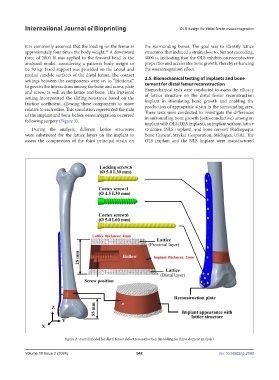
            following surgery (Figure 3).
                                                               implant with OLS (OLS implant), an implant without lattice
               During the analysis, different lattice structures   structure (NLS  implant), and  bone cement (Radiopaque
            were substituted for the lattice layers on the implant to   Bone Cement, Stryker Corporation, Michigan, USA). The
            assess  the  compression  of  the  third principal  strain  on   OLS  implant  and  the  NLS  implant  were  manufactured


                             Figure 2. Overall model for distal femur defect reconstruction (modeling for finite element analysis).


            Volume 10 Issue 2 (2024)                       548                                doi: 10.36922/ijb.2590

