


Page 560 - IJB-10-2
P. 560
International Journal of Bioprinting                              OLS design for distal femur osseointegration


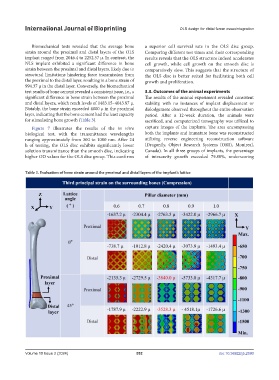
               Biomechanical tests revealed that the average bone   a superior cell survival rate in the OLS disc group.
            strain around the proximal and distal layers of the OLS   Comparing different test times and their corresponding
            implant ranged from 2046.4 to 2252.57 μ. In contrast, the   results reveals that the OLS structure indeed accelerates
            NLS implant exhibited a significant difference in bone   cell growth, while cell growth on the smooth disc is
            strain between the proximal and distal layers, likely due to   comparatively slow. This suggests that the structure of
            structural limitations hindering force transmission from   the  OLS  disc  is  better  suited  for  facilitating  both  cell
            the proximal to the distal layer, resulting in a bone strain of   growth and proliferation.
            994.37 μ in the distal layer. Conversely, the biomechanical
            test results of bone cement revealed a consistent issue, i.e., a   3.3. Outcomes of the animal experiments
            significant difference in bone strain between the proximal   The results of the animal experiment revealed consistent
            and distal layers, which reach levels of 1483.15–4043.87 μ.   stability, with no instances of implant displacement or
            Notably, the bone strain exceeded 4000 μ in the proximal   dislodgement observed throughout the entire observation
            layer, indicating that the bone cement had the least capacity   period. After a 12-week duration, the animals were
            for stimulating bone growth (Table 3).             sacrificed, and computerized tomography was utilized to
               Figure 7 illustrates the results of the  in vitro   capture images  of the implants. The area encompassing
            biological test, with the transmittance wavelengths   both the implants and immature bone was reconstructed
            ranging approximately from 300 to 1000 nm. After 24   utilizing reverse engineering reconstruction software
            h of testing, the OLS disc exhibits significantly lower   (Dragonfly,  Object  Research  Systems  (ORS),  Montreal,
            solution transmittance than the smooth disc, indicating   Canada). In all three groups of implants, the percentage
            higher OD values for the OLS disc group. This confirms   of  intracavity  growth  exceeded  79.80%,  underscoring


            Table 2. Evaluation of bone strain around the proximal and distal layers of the implant’s lattice


            Volume 10 Issue 2 (2024)                       552                                doi: 10.36922/ijb.2590

