


Page 565 - IJB-10-2
P. 565
International Journal of Bioprinting                              OLS design for distal femur osseointegration


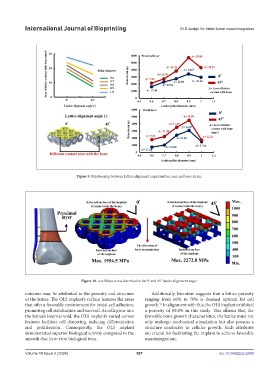
                                  Figure 9. Relationship between lattice alignment angle/surface area and bone strain.


                                    Figure 10. von Mises stress distribution for 0° and 45° lattice alignment angle.

            outcome may be attributed to the porosity and structure   Additionally, literature suggests that a lattice porosity
            of the lattice. The OLS implant’s surface features flat areas   ranging from 60% to 70% is deemed optimal for cell
            that offer a favorable environment for initial cell adhesion,   growth.  In alignment with this, the OLS implant exhibited
                                                                     56
            promoting cell stabilization and survival. As cells grow into   a porosity of 69.8% in this study. This affirms that, for
            the lattice’s internal void, the OLS implant’s varied corner   favorable bone growth characteristics, the lattice must not
            features facilitate cell clustering, inducing differentiation   only undergo mechanical stimulation but also possess a
            and proliferation. Consequently, the OLS implant   structure conducive to cellular growth. Such attributes
            demonstrated superior biological activity compared to the   are crucial for facilitating the implant to achieve favorable
            smooth disc in in vitro biological tests.          osseointegration.


            Volume 10 Issue 2 (2024)                       557                                doi: 10.36922/ijb.2590

