


Page 563 - IJB-10-2
P. 563
International Journal of Bioprinting                              OLS design for distal femur osseointegration


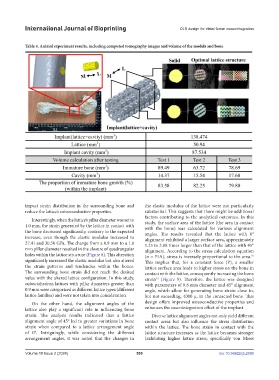
            Table 4. Animal experiment results, including computed tomography images and volume of the models and bone


            impact strain distribution in the surrounding bone and   the elastic modulus of the lattice were not particularly
            reduce the lattice’s osteoconductive properties.   substantial. This suggests that there might be additional
                                                               factors contributing to the analytical outcomes. In this
               Interestingly, when the lattice’s pillar diameter was set to
            1.0 mm, the strain generated by the lattice in contact with   study, the surface area of the lattice (the area in contact
                                                               with the bone) was calculated for various alignment
            the bone decreased significantly, contrary to the expected   angles. The results revealed that the lattice with 0°
            increase, even though the elastic modulus increased to   alignment exhibited a larger surface area, approximately
            27.41 and 30.50 GPa. The change from a 0.9 mm to a 1.0   1.25 to 2.88 times larger than that of the lattice with 45°
            mm pillar diameter resulted in the closure of quadrangular   alignment. According to the stress calculation equation
            holes within the lattice structure (Figure 8). This alteration   (σ = P/A), stress is inversely proportional to the area.
                                                                                                            16
            significantly increased the elastic modulus but also altered   This implies that, for a constant force (P), a smaller
            the strain patterns and tendencies within the bones.   lattice surface area leads to higher stress on the bone in
            The surrounding bone strain did not reach the desired   contact with the lattice, consequently increasing the bone
            value with the altered lattice configuration. In this study,   strain  (Figure 9). Therefore, the lattice was designed
                                                                    53
            cuboctahedron lattices with pillar diameters greater than   with parameters of 0.8 mm diameter and 45° alignment
            0.9 mm were categorized as different lattice types (different   angle, which allow for generating bone strain close to,
            lattice families) and were not taken into consideration.  but not exceeding, 4000 μ, in the contacted bone. This
               On the other hand, the alignment angles of the   design offers improved osteoconductive properties and
            lattice also play  a  significant role  in  influencing  bone   enhances the osseointegration effect of the implant.
            strain. The analysis results indicated that a lattice   Diverse lattice alignment angles not only yield different
            alignment angle of 45° led to greater variations in bone   contact areas but also influence the stress distribution
            strain when compared to a lattice arrangement angle   within  the lattice. The bone strain in contact with the
            of 0°. Intriguingly, while considering the different   lattice structure increases as the lattice becomes stronger
            arrangement angles, it  was  noted  that  the  changes in   (exhibiting higher lattice stress, specifically von Mises


            Volume 10 Issue 2 (2024)                       555                                doi: 10.36922/ijb.2590

