


Page 555 - IJB-10-2
P. 555
International Journal of Bioprinting OLS design for distal femur osseointegration
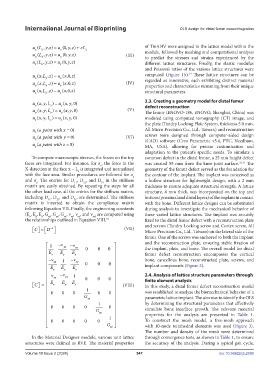
uL yz(, ,) = u (,0 y z,) + ε L x of Ti6Al4V were assigned to the lattice model within the
x
x
x
uL yz(, ,) = u (,0 y z,) (III) module, followed by meshing and computational analysis
x
to predict the stresses and strains experienced by the
y
y
uL yz(, ,) = u (00, ,)yz different lattice structures. Finally, the elastic modulus
z
z
x
and Poisson’s ratios of the various lattice structures were
34
ux Lz(, y ,) = ux(, ,)0 z computed (Figure 1b). These lattice structures can be
x
x
ux Lz(, y ,) = ux(, ,)0 z (IV) regarded as innovative, each exhibiting distinct material
properties and characteristics stemming from their unique
y
y
ux Lz ,) = ux (, , 0 zz) structural parameters.
(,
z
y
z
ux yL(, , z ) = ux y(, ,)0 2.3. Creating a geometry model for distal femur
x
defect reconstruction
z
ux yL(, , z ) = ux y(, ,)0 (V) The femur (ENOVO-186, ENOVO, Shanghai, China) was
y
y
ux yL ) = ux y, 00) modeled using computed tomography (CT) image, and
(,
(, ,
z
z
z
the plate (Tandry Locking Plate System, thickness 5.0 mm,
ua po( int with x = 0 ) All Micro Precision Co., Ltd., Taiwan) and reconstruction
x
ua po( int with y = 0 ) (VI) screws were designed through computer-aided design
y
(CAD) software (Creo Parametric v5.0, PTC, Needham,
ua po( int with z = 0 ) MA, USA), allowing for precise customization and
z
adaptation to the patient’s specific needs. To simulate a
To compute macroscopic stresses, the forces on the top common defect in the distal femur, a 25 mm height defect
faces are integrated. For instance, for σ , the force in the was created 55 mm from the knee joint surface. 35,36 The
x
X-direction at the face x = L is integrated and normalized geometry of the femur defect served as the foundation for
x
with the face area. Similar procedures are followed for σ y the contour of the implant. The implant was conceived as
and σ . The entries for D , D , and D in the stiffness a hollow structure for lightweight design, with a 2 mm
z
21
31
11
matrix are easily obtained. By repeating the steps for all thickness to ensure adequate structural strength. A lattice
the other load case, all the entries for the stiffness matrix, structure, 4 mm thick, was incorporated on the top and
including D , D , and D , are determined. The stiffness bottom (proximal and distal layers) of the implant in contact
11
31
21
matrix is inverted to obtain the compliance matrix with the bone. Different lattice designs can be substituted
following Equation VII. Finally, the engineering constants during analysis to investigate the mechanical behavior of
(E , E , E , G , G , G , ν , ν , and ν are computed using these varied lattice structures. The implant was securely
yz
xy
y
xz)
z
x
yz
xz
xy
the relationships outlined in Equation VIII. 34 fixed to the distal femur defect with a reconstruction plate
and screws (Tandry Locking screw and Cortex screw, All
C =
D (VII) Micro Precision Co., Ltd., Taiwan) on the lateral side of the
−1
femur. One of the screws was anchored to both the implant
1 v − yx v − and the reconstruction plate, ensuring stable fixation of
zx 0 0 0 the implant, plate, and bone. The overall model for distal
E x E y E z femur defect reconstruction encompasses the cortical
v − 1 v − bone, cancellous bone, reconstructed plate, screws, and
xy zy 0 0 0
E x E y E z implant components (Figure 2).
v − xz v − yz 1 2.4. Analysis of lattice structure parameters through
E E E 0 0 0 0 finite element analysis
C =
x y z (VIII) In this study, a distal femur defect reconstruction model
1
0 0 0 G 0 0 was established to analyze the biomechanical behavior of a
xy parametric lattice implant. The aim was to identify the OLS
1 by determining the structural parameters that effectively
0 0 0 0 0 stimulate bone interface growth. The relevant material
G yz
1 properties for the analysis are presented in Table 1.
0 0 0 0 0 To construct the mesh model, a free-mesh approach
G with 10-node tetrahedral elements was used (Figure 3).
xz
The number and density of the mesh were determined
In the Material Designer module, various unit lattice through convergence tests, as shown in Table 1, to ensure
structures were defined as RVE. The material properties the accuracy of the analysis. During a typical gait cycle,
Volume 10 Issue 2 (2024) 547 doi: 10.36922/ijb.2590

