


Page 71 - IJB-10-2
P. 71
International Journal of Bioprinting                                         Advancements in 3D printing


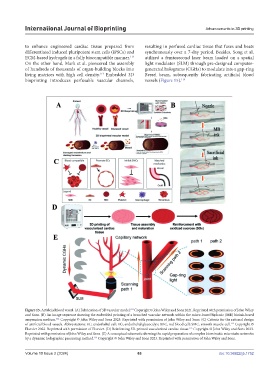
            to enhance engineered cardiac tissue prepared from   resulting in perfused cardiac tissue that fuses and beats
            differentiated induced pluripotent stem cells (iPSCs) and   synchronously over a 7-day period. Besides, Song et al.
            ECM-based hydrogels in a fully biocompatible manner.    utilized a femtosecond laser  beam loaded on a  spatial
                                                         113
            On the other hand, Mark et al. pioneered the assembly   light modulator (SLM) through pre-designed computer-
            of hundreds of thousands of organ-building blocks into   generated holograms (CGHs) to modulate into a gap-ring
            living matrices with high cell density.  Embedded 3D   Bessel  beam,  subsequently  fabricating  artificial  blood
                                            114
            bioprinting introduces perfusable vascular channels,   vessels (Figure 15). 114


                                                         110
            Figure 15. Artificial blood vessel. (A) Fabrication of 3D vascular model.  Copyright © John Wiley and Sons 2021. Reprinted with permission of John Wiley
            and Sons. (B) An image sequence showing the embedded printing of a branched vascular network within the micro-based biphasic (MB) bioink-based
                         111
            suspension medium.  Copyright © John Wiley and Sons 2023. Reprinted with permission of John Wiley and Sons. (C) Criteria for the rational design
                                                                                                   112
            of artificial blood vessels. Abbreviations: EC, endothelial cell; EG, endothelial glycocalyx; RBC, red blood cell; SMC, smooth muscle cell.  Copyright ©
            Elsevier 2022. Reprinted with permission of Elsevier. (D) Reinforcing 3D-printed vascularized cardiac tissue.  Copyright © John Wiley and Sons 2023.
                                                                                  113
            Reprinted with permission of John Wiley and Sons. (E) A conceptual schematic showing the rapid preparation of complex biomimetic microtube networks
                                         114
            by a dynamic holographic processing method.  Copyright © John Wiley and Sons 2023. Reprinted with permission of John Wiley and Sons.
            Volume 10 Issue 2 (2024)                        63                                doi: 10.36922/ijb.1752

