


Page 62 - IJB-3-1
P. 62
Caroline  Murphy,  Krishna  Kolan,  Wenbin  Li,  et  al.

            viscosity.  The  minimum  air  pressure  required  to  ex-  (12 layers). The scaffold fabricated with C5 paste had
            trude the paste increased when glass content was in-  enough  strength  to  be  safely  handled  for  subsequent
            creased from 10 wt. % to 30 wt. %. At higher glass   degradation and in vitro assessment.
            content (40 wt. % and 50 wt. %), the nozzle clogged   SEM images of scaffolds fabricated with C5 paste
            during fabrication. Therefore, additional CF (about 1   are shown in Figure 3. Figures 3A and 3B show the
            mL) was added to the paste to reduce the viscosity for   surface  morphology  of  the  filament.  Glass  particles
            clog-free  extrusion  using  the  25G  tip.  The  13-93B3   are conspicuously absent from the surface of filaments.
            glass  weight  percentage  and  PCL:  CF  ratios  used  to   No pores on the filament surface were detected even
            make composite pastes are shown in Table 1. The fi-  when observed at a 2000× magnification. Figures 3C
            nal  printing parameters  used  to fabricate the compo-  and  3D  show  the  filament  cross-sectional  surface.
            site scaffolds containing 50 wt. % 13-93B3 glass con-  Glass  particles  dispersed  in  the  PCL  matrix  can  be
            tent is also provided in Table 1.                  seen in the interior. The dissolved PCL in chloroform
                                                               encloses  the  glass  particles  and  surface  tension  ef-
            Table 1.  PCL/13-93B3  glass  paste  compositions  and  printing   fects between the nozzle tip and PCL during extrusion
            parameters                                         appear to have caused the presence of only PCL on the
             Composite  13-93B3 Glass   PCL:CF   Final Printing Parameters   surface.
              Paste #   (wt. %)  (g to mL)   (using C5 paste)
                C1       10        5:3   Printing speed – 8 mm/s   3.2 Degradation and Bioactivity of PCL/13-93B3
                C2       20        5:3   Dwell time – 2 min    Glass Composite
                C3       30        5:3   Layer height – 0.1 mm   Recent studies suggest that cell culture medium can be
                C4       40        5:4   Air pressure – 30 psi   used as an alternative to simulated body fluid (SBF) to
                C5       50        5:4   Nozzle tip – 260 µm   evaluate the bioactivity of the materials, with no sig-
                                                               nificant differences in the formation of hydroxyapatite
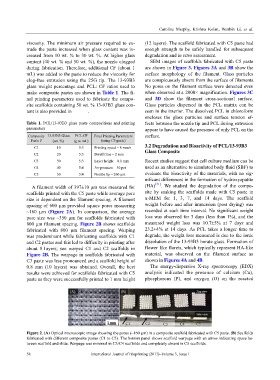
               A filament width of 397±10 μm was measured for   (HA) [31] .  We  studied  the  degradation  of  the  compo-
            scaffolds printed with the C5 paste while average pore   site  by  soaking  the  scaffolds  made  with  C5  paste  in
            size is dependent on the filament spacing. A filament   α-MEM  for  1,  3,  7,  and  14  days.  The  scaffold
            spacing of 600 µm provided square pores measuring   weight before and after immersion (post drying) was
            ~160  µm  (Figure 2A).  In  comparison,  the  average   recorded at each time interval. No significant weight
            pore size was ~350 µm for scaffolds fabricated with   loss was observed for 3 days (less than 1%), and the
            800 µm filament spacing. Figure 2B shows scaffolds   measured  weight  loss  was  10.7±5%  at  7  days  and
            fabricated  with  800  µm  filament  spacing.  Warping   23.2±4% at 14  days. As  PCL takes  a longer time  to
            was predominant while fabricating scaffolds with C1   degrade, the weight loss measured is due to the ionic
            and C2 pastes and this led to difficulty in printing after   dissolution of the 13-93B3 borate glass. Formation of
            about  8 l ayers;  see  warped  C1  and  C2  scaffolds  in   flower like florets, which typically represent HA-like
            Figure 2B. The warpage in scaffolds fabricated with   material,  was  observed  on  the  filament  surface  as
            C3 paste was less pronounced and a scaffold height of   shown in Figures 4A and 4B.
            0.8  mm  (10  layers)  was  obtained.  Overall,  the  best   The  energy-dispersive  X-ray  spectroscopy  (EDX)
            results were achieved for scaffolds fabricated with C5   analysis  indicated  the  presence  of  calcium  (Ca),
            paste as they were successfully printed to 1 mm height   phosphorous  (P),  and  oxygen  (O)  on  the  reacted


            Figure 2. (A) Optical microscopic image showing the pores (~160 µm) in a composite scaffold fabricated with C5 paste. (B) Scaffolds
            fabricated with different composite pastes (C1 to C5). The bottom panel shows scaffold warpage with an arrow indicating space be-
            tween scaffold and slide. Warpage was minimal in C3/C4 scaffolds and completely absent in C5 scaffolds.

            58                          International Journal of Bioprinting (2017)–Volume 3, Issue 1

