


Page 63 - IJB-3-1
P. 63
3D bioprinting of stem cells and polymer/bioactive glass composite scaffolds for bone tissue engineering


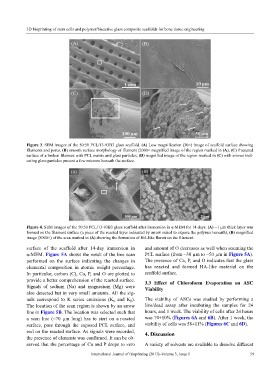
            Figure 3. SEM images of the 50:50 PCL/13-93B3 glass scaffold. (A) Low magnification (30×) image of scaffold surface showing
            filaments and pores, (B) smooth surface morphology of filament (2000× magnified image of the region marked in (A), (C) fractured
            surface of a broken filament with PCL matrix and glass particles, (D) magnified image of the region marked in (C) with arrows indi-
            cating glass particles present a few microns beneath the surface.


            Figure 4. SEM images of the 50:50 PCL/13-93B3 glass scaffold after immersion in α-MEM for 14 days. (A) ~1 µm thick layer was
            formed on the filament surface (a piece of the reacted layer indicated by arrow raised to expose the polymer beneath), (B) magnified
            image (8000×) of the area marked in (A) showing the formation of HA-like florets on the filament.

            surface  of  the  scaffold  after  14-day  immersion  in   and amount of O decreases as well when scanning the
            α-MEM. Figure 5A shows the result of the line scan   PCL surface (from ~30 µm to ~50 µm in Figure 5A).
            performed  on  the  surface  indicating  the  changes  in   The presence of Ca, P, and O indicates that the glass
            elemental  composition  in  atomic  weight  percentage.   has  reacted  and  formed  HA-like  material  on  the
            In particular, carbon (C), Ca, P, and O are plotted to   scaffold surface.
            provide a better comprehension of the reacted surface.   3.3  Effect of Chloroform Evaporation on ASC
            Signals  of  sodium  (Na)  and  magnesium  (Mg)  were   Viability
            also detected but in very small amounts. All the sig-
            nals  correspond  to  K  series  emissions  (K α  and  K β).   The  viability  of  ASCs  was  studied  by  performing  a
            The location of the scan region is shown by an arrow   live/dead  assay  after  incubating  the  samples  for  24
            line in Figure 5B. The location was selected such that   hours, and 1 week. The viability of cells after 24 hours
            a  scan  line  (~70  µm  long)  has  to  start  on  a r eacted   was 70±10% (Figures 6A and 6B). After 1 week, the
            surface,  pass  through  the  exposed  PCL  surface,  and   viability of cells was 58±11% (Figures 6C and 6D).
            end on the reacted surface. As signals were recorded,   4. Discussion
            the presence of elements was confirmed. It can be ob-
            served that the percentage of Ca and P drops to zero   A variety of solvents are available to dissolve different

                                        International Journal of Bioprinting (2017)–Volume 3, Issue 1      59

