


Page 64 - IJB-3-1
P. 64
Caroline  Murphy,  Krishna  Kolan,  Wenbin  Li,  et  al.


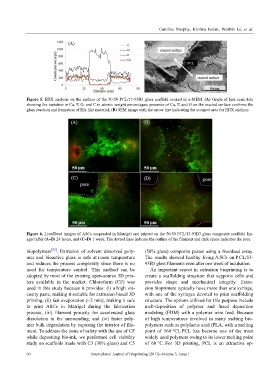
            Figure 5. EDX analysis on the surface of the 50:50 PCL/13-93B3 glass scaffold soaked in α-MEM. (A) Graph of line scan data
            showing the variation in Ca, P, O, and C in atomic weight percentages; presence of Ca, P, and O on the reacted surface confirms the
            glass reaction and formation of HA-like material, (B) SEM image with the arrow line indicating the scanned area for EDX analysis.


            Figure 6. Live/Dead images of ASCs suspended in Matrigel and printed on the 50:50 PCL/13-93B3 glass composite scaffold. Im-
            aged after (A–B) 24 hours, and (C–D) 1 week. The dotted lines indicate the outline of the filament and dark space indicates the pore.

            biopolymers [32] .  Extrusion  of  solvent  dissolved  poly-  (50% glass) composite pastes using a live/dead assay.
            mer  and  bioactive  glass  is  safe  at r oom  temperature   The  results  showed  healthy  living A SCs  on P CL/13-
            and reduces the process complexity since there is no   93B3 glass filaments even after one week of incubation.
            need  for  temperature  control.  This  method  can  be   An  important  aspect  in  extrusion  bioprinting  is  to
            adopted by most of the existing open-source 3D prin-  create  a  scaffolding  structure  that  supports  cells  and
            ters  available  in  the  market.  Chloroform  (CF)  was   provides  shape  and  mechanical  integrity.  Extru-
            used in this study because it provides: (i) a high vis-  sion bioprinters typically have more than one syringe,
            cosity paste, making it suitable for extrusion-based 3D   with one of the syringes devoted to print scaffolding
            printing, (ii) fast evaporation (~2 min), making it safe   structure. The options utilized for this purpose include
            to  print  ASCs  in  Matrigel  during  the  fabrication   melt-deposition  of  polymer  and  fused  deposition
            process,  (iii)  filament  porosity  for  accelerated  glass   modeling (FDM) with a polymer wire feed. Because
            dissolution  to  the  surrounding,  and  (iv)  faster  poly-  of  high  temperatures  involved  in  many  melting  bio-
            mer bulk degradation by exposing the interior of fila-  polymers such as polylactic acid (PLA, with a melting
            ment. To address the issue of safety with the use of CF   point  of  160 °C), PCL  has  become  one  of  the  most
            while depositing bio-ink, we performed cell viability   widely used polymers owing to its lower melting point
            study on scaffolds made with C3 (30% glass) and C5   of  60 °C. For  3D  printing,  PCL  is  an  attractive  op-

            60                          International Journal of Bioprinting (2017)–Volume 3, Issue 1

