


Page 156 - IJB-10-3
P. 156
International Journal of Bioprinting                                           3D bone: Current & future


            become impervious to nutrients, and the chondrocytes   2.3.2. Stem cells and bone differentiation
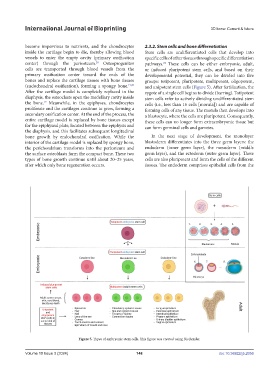
            inside the cartilage begin to die, thereby allowing blood   Stem cells are undifferentiated cells that develop into
            vessels to enter  the empty cavity (primary ossification   specific cells of other tissues through specific differentiation
            center) through the periosteum.  Osteoprogenitor   pathways.  These cells can be either embryonic, adult,
                                          20
                                                                       22
            cells are transported through blood vessels from the   or induced pluripotent stem cells, and based on their
            primary ossification center toward the ends of the   developmental potential, they can be divided into five
            bones and replace the cartilage tissues with bone tissues   groups: totipotent, pluripotent, multipotent, oligopotent,
            (endochondral ossification), forming a spongy bone. 19,20    and unipotent stem cells (Figure 5). After fertilization, the
            After the cartilage model is completely replaced in the   zygote of a single cell begins to divide (barring). Totipotent
            diaphysis, the osteoclasts open the medullary cavity inside   stem cells refer to actively dividing undifferentiated stem
            the bone.  Meanwhile, in the epiphyses, chondrocytes   cells (i.e., less than 16 cells [morula]) and are capable of
                    19
            proliferate and the cartilages continue to grow, forming a   forming cells of any tissue. The morula then develops into
            secondary ossification center. At the end of the process, the   a blastocyte, where the cells are pluripotent. Consequently,
            entire cartilage model is replaced by bone tissues except   these cells can no longer form extraembryonic tissue but
            for the epiphyseal plate, located between the epiphysis and   can form germinal cells and gametes.
            the diaphysis, and this facilitates subsequent longitudinal
            bone growth by endochondral ossification. While the   In the next stage of development, the monolayer
            interior of the cartilage model is replaced by spongy bone,   blastoderm differentiates into the three germ layers: the
            the perichondrium transforms into the periosteum and   endoderm (inner germ layer), the mesoderm (middle
            the surface osteoblasts form the compact bone. These two   germ layer), and the ectoderm (outer germ layer). These
            types of bone growth continue until about 20–25 years,   cells are also pluripotent and form the cells of the different
            after which only bone regeneration occurs.         tissues. The endoderm comprises epithelial cells from the


                                   Figure 5. Types of embryonic stem cells. This figure was created using BioRender.


            Volume 10 Issue 3 (2024)                       148                                doi: 10.36922/ijb.2056

