


Page 157 - IJB-10-3
P. 157
International Journal of Bioprinting                                           3D bone: Current & future


            urogenital, gastrointestinal, respiratory, pharyngeal, and   respectively.  Induced pluripotent stem cells are stem cells
                                                                         21
            thyroid glands. The mesoderm contributes to most circular   that can be produced directly from somatic cells. 21,23-25
            skeletal systems and the kidneys. The ectoderm forms the   MSCs are a type of stem cell commonly found in the
            dermis of the skin, the nervous system, tooth enamel,   adult body (e.g., in the umbilical cord, bone marrow,
            dental cement, dentin, the epithelium of the esophagus,   and adipose tissue) and can differentiate into cells from
            the lens of the eye, and the cornea.  Upon differentiation,   a variety of tissues, such as bones (i.e., via osteogenesis),
                                        23
            these multipotent adult stem cells can no longer be used to   cartilages (i.e., via chondrogenesis), and the bone marrow
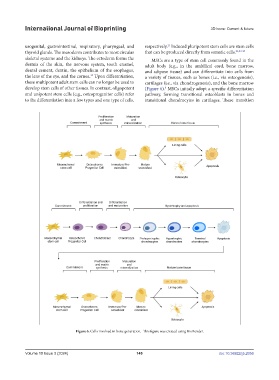
            develop stem cells of other tissues. In contrast, oligopotent   (Figure 6).  MSCs initially adopt a specific differentiation
                                                                       8
            and unipotent stem cells (e.g., osteoprogenitor cells) refer   pathway, forming transitional osteoblasts in bones and
            to the differentiation into a few types and one type of cells,   transitional chondrocytes in cartilages. These transition


                                 Figure 6. Cells involved in bone generation.  This figure was created using BioRender.


            Volume 10 Issue 3 (2024)                       149                                doi: 10.36922/ijb.2056

