


Page 492 - IJB-10-3
P. 492
International Journal of Bioprinting                                Stretchable scaffold for modeling fibrosis


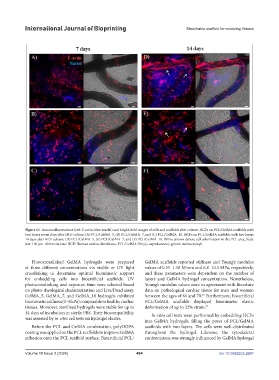
            Figure 11. Immunofluorescence (red: F-actin; blue: nuclei) and bright-field images of cells and scaffolds after culture. HCFs on PCL/GelMA scaffolds with
            two layers seven days after HCF culture: (A) PCL/GelMA_5, (B) PCL/GelMA_7, and (C) PCL/GelMA_10. HCFs on PCL/GelMA scaffolds with two layers
            14 days after HCF culture: (D) PCL/GelMA_5, (E) PCL/GelMA_7, and (F) PCL/GelMA_10. White arrows denote cell colonization in the PCL area. Scale
            bar: 100 µm. Abbreviations: HCF: Human cardiac fibroblasts; PCL/GelMA: Poly(ε-caprolactone)-gelatin methacryloyl.


               Photocrosslinked GelMA hydrogels were prepared   GelMA scaffolds reported stiffness and Young’s modulus
            at  three different  concentrations  via visible  or  UV  light   values of 0.51–1.18 N/mm and 6.8–10.5 MPa, respectively,
            crosslinking to determine optimal biomimetic support   and these parameters were dependent on the number of
            for embedding cells into bioartificial scaffolds. UV   layers and GelMA hydrogel concentration. Nonetheless,
            photocrosslinking and exposure time were selected based   Young’s modulus values were in agreement with literature
            on photo-rheological characterization and Live/Dead assay.   data on pathological cardiac tissue for men and women
            GelMA_5, GelMA_7, and GelMA_10 hydrogels exhibited   between the ages of 61 and 70.  Furthermore, bioartificial
                                                                                       27
            biomimetic stiffness (1–8 kPa) comparable to healthy cardiac   PCL/GelMA scaffolds displayed biomimetic elastic
            tissues. Moreover, sterilized hydrogels were stable for up to   deformation of up to 22% strain. 25
            14 days of incubation in sterile PBS. Their biocompatibility   In vitro cell tests were performed by embedding HCFs
            was assessed by in vitro cell tests on hydrogel eluates.
                                                               into GelMA hydrogels, filling the pores of PCL/GelMA
               Before the PCL and GelMA combination, polyDOPA   scaffolds with two layers. The cells were well-distributed
            coating was applied on the PCL scaffolds to improve GelMA   throughout the hydrogel. Likewise, the cytoskeletal
            adhesion onto the PCL scaffold surface. Bioartificial PCL/  conformation was strongly influenced by GelMA hydrogel


            Volume 10 Issue 3 (2024)                       484                                doi: 10.36922/ijb.2247

