


Page 491 - IJB-10-3
P. 491
International Journal of Bioprinting                                Stretchable scaffold for modeling fibrosis


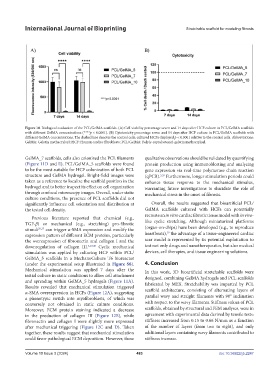
            Figure 10. Biological evaluation of the PCL/GelMA scaffolds. (A) Cell viability percentage seven and 14 days after HCF culture in PCL/GelMA scaffolds
            with different GelMA concentrations (****p < 0.0001). (B) Cytotoxicity percentage seven and 14 days after HCF culture in PCL/GelMA scaffolds with
            different GelMA concentrations. The dashed line denotes the control cells; cultured HCFs displayed p < 0.0001 relative to the control cells. Abbreviations:
            GelMA: Gelatin methacryloyl; HCF: Human cardiac fibroblasts; PCL/GelMA: Poly(ε-caprolactone)-gelatin methacryloyl.


            GelMA_7 scaffolds, cells also colonized the PCL filaments    qualitative observations should be validated by quantifying
            (Figure 11D and E). PCL/GelMA_5 scaffolds were found   protein production using immunoblotting and analyzing
            to be the most suitable for HCF colonization of both PCL   gene expression via real-time polymerase chain reaction
            structure and GelMA hydrogel. Bright-field images were   (qPCR).  Furthermore, longer stimulation periods could
                                                                     5,29
            taken as a reference to localize the scaffold position in the   enhance tissue response to the mechanical stimulus,
            hydrogel and to better inspect its effect on cell organization   warranting  future  investigations  to  elucidate  the  role  of
            through confocal microscopy images. Overall, under static   mechanical stress in the onset of fibrosis.
            culture conditions, the presence of PCL scaffolds did not
            significantly influence cell orientation and distribution at   Overall, the results suggested that bioartificial PCL/
            the tested cell density.                           GelMA scaffolds cultured with HCFs can potentially
                                                               recreate an in vitro cardiac fibrotic tissue model with in vivo-
               Previous literature reported that chemical (e.g.,
            TGF-β) or mechanical (e.g., stretching) pro-fibrotic   like cyclic stretching. Although miniaturized platforms
            stimuli 29,37  can trigger α-SMA expression and modify the   (organ-on-chips) have been developed (e.g., to reproduce
                                                                        29
            expression pattern of different ECM proteins, particularly   heartbeats),  the advantage of a tissue-engineered cardiac
            the overexpression of fibronectin and collagen I and the   scar model is represented by its potential exploitation to
            downregulation  of  collagen  III. 5,37,48   Cyclic  mechanical   test not only drugs and nanotherapeutics, but also medical
            stimulation was applied by culturing HCF within PCL/  devices, cell therapies, and tissue engineering solutions.
            GelMA_5  scaffolds  in  a  MechanoCulture  T6  bioreactor
            (under the experimental setup illustrated in  Figure S6).   4. Conclusion
            Mechanical stimulation was applied 7 days after the   In this work, 3D bioartificial stretchable scaffolds were
            initial culture in static conditions to allow cell attachment   designed, combining GelMA hydrogels and PCL scaffolds
            and spreading within GelMA_5 hydrogels (Figure 11A).   fabricated by MEX. Stretchability was imparted by PCL
            Results revealed that mechanical stimulation triggered
            α-SMA overexpression in HCFs (Figure 12A), suggesting   scaffold architecture, consisting of alternating layers of
            a phenotypic  switch into myofibroblasts, of which  was   parallel wavy and straight filaments with 90° inclination
            conversely not obtained in static culture conditions.   with respect to the wavy filaments. Stiffness values of PCL
            Moreover,  ECM  protein  staining  indicated  a  decrease   scaffolds, obtained by structural and FEM analyses, were in
            in the production of collagen III (Figure 12B), while   agreement with experimental data derived by tensile tests:
            fibronectin and collagen I were slightly more expressed   stiffness increased from 0.15 to 0.66 N/mm as a function
            after  mechanical  triggering  (Figure  12C  and  D).  Taken   of the number of layers (from two to eight), and only
            together, these results suggest that mechanical stimulation   additional layers containing wavy filaments contributed to
            could favor pathological ECM deposition. However, these   stiffness increase.


            Volume 10 Issue 3 (2024)                       483                                doi: 10.36922/ijb.2247

