


Page 622 - IJB-10-3
P. 622
International Journal of Bioprinting                       Wireless module system applied on 3D-printed implant


            the removed bone segmental defect was approximately   leading to implant fracture when occlusal force was applied
                                                                                     12
            6 g,  implying the  potential  for further  reduction  in the   on the 3D-printed implant.  Results from biomechanical
            volume of the WMS and the lightweight design of the   in vitro fatigue tests revealed that strain values increased
            3D-printed implant.                                with higher applied force levels at the same load positions.
                                                               Moreover, the strain received was higher when occlusal
               In the biomechanical fatigue test, attaching strain   force was applied on the premolar under identical force
            gauges to the inner right buccal wall near the fixation wing   application conditions, indicating  that the  premolar was
            was based on our previous FE study that highlighted this   closer to the strain gauge attachment location within the
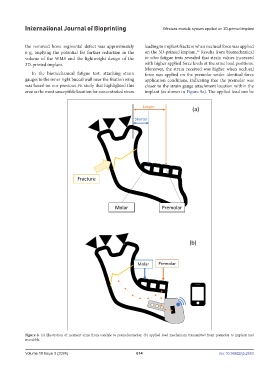
            area as the most susceptible location for concentrated stress   implant (as shown in Figure 8a). The applied load can be


            Figure 8. (a) Illustration of moment arms from condyle to premolar/molar; (b) applied load mechanism transmitted from premolar to implant and
            mandible.

            Volume 10 Issue 3 (2024)                       614                                doi: 10.36922/ijb.2553

