


Page 621 - IJB-10-3
P. 621
International Journal of Bioprinting                       Wireless module system applied on 3D-printed implant


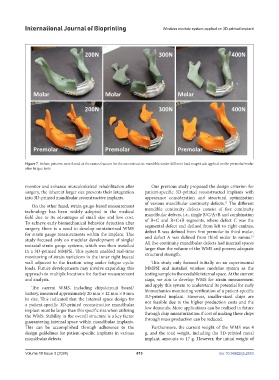
            Figure 7. Failure patterns were found at the ramus fracture for the reconstructive mandible under different load magnitude applied on the premolar/molar
            after fatigue tests.


            monitor and enhance musculoskeletal rehabilitation after   Our previous study proposed the design criterion for
            surgery, the inherent larger size prevents their integration   patient-specific 3D-printed reconstructed implants with
            into 3D-printed mandibular reconstructive implants.  appearance  consideration and structural  optimization
                                                               of various mandibular continuity defects.  The different
                                                                                                 12
               On the other hand, strain gauge-based measurement
            technology has been widely adopted in the medical   mandible continuity defects consist of five continuity
                                                               mandibular defects, i.e., single B/C/A+B and combination
            field due to its advantages of small size and low cost.   of B+C and B+C+B segments, where defect C was the
            To achieve early biomechanical behavior detection after
            surgery, there is a need to develop miniaturized WMS   segmental  defect  and defined  from  left  to right canines,
            for strain gauge measurements within the implant. This   defect B was defined from first premolar to third molar,
                                                                                                            12
            study focused only on modular development of single/  and defect A was defined from third molar to ramus.
            uniaxial strain gauge systems, which was then installed   All five continuity mandibular defects had internal spaces
            in a 3D-printed MMPSI. This system enabled real-time   larger than the volume of the WMS and possess adequate
            monitoring of strain variations in the inner right buccal   structural strength.
            wall adjacent to the fixation wing under fatigue cyclic   This study only focused initially on an experimental
            loads. Future developments may involve expanding this   MMPSI and installed wireless modulus system as the
            approach to multiple locations for further measurement   testing sample in the available internal space. At the current
            and analysis.                                      stage, we aim to develop WMS for strain measurement
                                                               and apply this system to understand its potential for early
               The current WMS, including chips/circuit board/
            battery, measured approximately 20 mm × 12 mm × 8 mm   biomechanics monitoring verification of a patient-specific
                                                               3D-printed  implant.  However,  smaller-sized  chips  are
            in size. This indicated that the internal space design for   not feasible due to the higher production costs and the
            a patient-specific 3D-printed reconstructive mandibular   low demands. More applications can be realized in future
            implant must be larger than this specific size when utilizing   through chip miniaturization if cost of making these chips
            the WMS. Stability in the overall structure is a key factor   through mass production can be reduced.
            guaranteeing internal space within mandibular implants.
            This can be accomplished through adherence to the     Furthermore, the current weight of the WMS was 4
            design guidelines for patient-specific implants in various   g, and the total weight, including the 3D-printed metal
            mandibular defects.                                implant, amounts to 17 g. However, the initial weight of


            Volume 10 Issue 3 (2024)                       613                                doi: 10.36922/ijb.2553

