


Page 623 - IJB-10-3
P. 623
International Journal of Bioprinting                       Wireless module system applied on 3D-printed implant


            transmitted from the premolar separately to the mandible   APP that enables stress condition assessment from our
            and the 3D-printed implant to receive higher strain values.  WMS employed for early monitoring after the surgery.
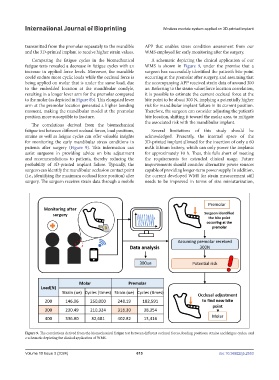
               Comparing the fatigue cycles in the biomechanical   A schematic depicting the clinical application of our
            fatigue tests revealed a decrease in fatigue cycles with an   WMS is shown in  Figure 9, under the premise that a
            increase  in  applied  force  levels.  Moreover,  the  mandible   surgeon has successfully identified the patient’s bite point
            could endure more cyclic loads while the occlusal force is   occurring at the premolar after surgery, and assuming that
            being applied on molar that is under the same load, due   the accompanying APP received strain data of around 300
            to the embedded location at the mandibular condyle,   ue. Referring to the strain value/force location correlation,
            resulting in a longer lever arm for the premolar compared   it is possible to estimate the current occlusal force at the
            to the molar (as depicted in Figure 8b). This elongated lever   bite point to be about 300 N, implying a potentially higher
            arm at the premolar location generated a higher bending   risk for mandibular implant failure in its current position.
            moment, making the mandibular model at the premolar   Therefore, the surgeon can consider adjusting the patient’s
            position more susceptible to fracture.             bite location, shifting it toward the molar area, to mitigate
                                                               the associated risk with the mandibular implant.
               The  correlations  derived  from  the  biomechanical
            fatigue test between different occlusal forces, load positions,   Several limitations of this study should be
            strains as well as fatigue cycles can offer valuable insights   acknowledged. Presently, the internal space of the
            for monitoring the early mandibular stress conditions in   3D-printed implant allowed for the insertion of only a 60
            patients after surgery (Figure 9). This information can   mAh lithium battery, which can only power the implants
            assist surgeons in providing advice on bite adjustment   for approximately 10 h. Thus, this falls short of meeting
            and recommendations to patients, thereby reducing the   the requirements for extended clinical usage. Future
            probability of 3D-printed implant failure. Typically, the   improvements should consider alternative power sources
            surgeon can identify the mandibular occlusion contact point   capable of providing longer-term power supply. In addition,
            (i.e., identifying the maximum occlusal force position) after   the current developed WMS for strain measurement still
            surgery. The surgeon receives strain data through a mobile   needs to be improved in terms of size miniaturization,


            Figure 9. The correlations derived from the biomechanical fatigue test between different occlusal forces, loading positions, strains and fatigue cycles, and
            a schematic depicting the clinical application of WMS.


            Volume 10 Issue 3 (2024)                       615                                doi: 10.36922/ijb.2553

