


Page 620 - IJB-10-3
P. 620
International Journal of Bioprinting                       Wireless module system applied on 3D-printed implant


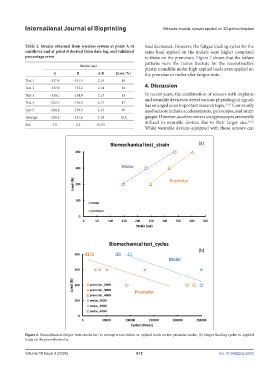
            Table 2. Strains obtained from wireless system at point A of   load decreased. However, the fatigue loading cycles for the
            cantilever and at point B derived from data log, and validated   same load applied on the molars were higher compared
            percentage error                                   to those on the premolars. Figure 7 shows that the failure
                                                               patterns were the ramus fracture for the reconstructive
                                   Strain (ue)
                                                               plastic mandible under high applied loads even applied on
                        A         B        A/B    Error (%)    the premolar or molar after fatigue tests.
            Test 1    -327.6    -151.5     2.16      16
            Test 2    -327.0    -152.6     2.14      14        4. Discussion
            Test 3    -330.1    -154.9     2.13      13        In recent years, the combination of sensors with implants
                                                               and wearable devices to detect various physiological signals
            Test 4    -322.7    -148.5     2.17      17
                                                               has emerged as an important research topic. 16,21  Commonly
            Test 5    -324.2    -150.3     2.16      16        used sensors include accelerometers, gyroscopes, and strain
            Average   -326.3    -151.6     2.15     15.2       gauges. However, accelerometers and gyroscopes are mostly
                                                               utilized in wearable devices due to their larger size. 16,21
            Std.       2.9       2.4      0.015
                                                               While wearable devices equipped with these sensors can


            Figure 6. Biomechanical fatigue tests results for (a) average strain values vs. applied loads on the premolar/molar; (b) fatigue loading cycles vs. applied
            loads on the premolar/molar.

            Volume 10 Issue 3 (2024)                       612                                doi: 10.36922/ijb.2553

