


Page 616 - IJB-10-3
P. 616
International Journal of Bioprinting                       Wireless module system applied on 3D-printed implant


            Table 1. Material properties input to FE analysis for aluminum   bone).  Those  contours  were  extracted  and  converted  to
            alloy cantilever beam                              reconstruct a 3D solid model of the mandible bone with
            Material        Young’s modulus (GPa)  Poisson’s ratio  segmental defect.
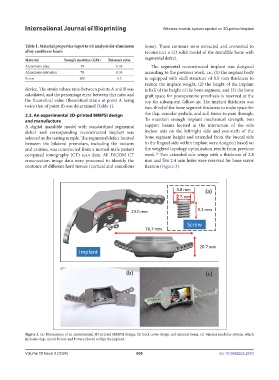
            Aluminum plate         70              0.33           The segmental reconstructed implant was designed
            Aluminum extrusion     70              0.33        according to the previous work, i.e., (1) the implant body
            Screw                  200             0.3         is equipped with shell structure of 0.5 mm thickness to
                                                               reduce the implant weight, (2) the height of the implant
            device. The strain values ratio between points A and B was   is half of the height of the bone segment, and (3) the bone
            calculated, and the percentage error between this ratio and   graft space for postoperative prosthesis is reserved at the
            the theoretical value (theoretical strain at point A being   top for subsequent follow-up. The implant thickness was
            twice that of point B) was determined (Table 1).   two-third of the bone segment thickness to make space for

            2.3. An experimental 3D-printed MMPSI design       the flap, vascular pedicle, and soft tissue to pass through.
            and manufacture                                    To maintain enough implant mechanical strength, two
            A digital mandible model with standardized segmental   support beams located at the interaction of the side
            defect and corresponding reconstructed implant was   incisor axis on the left/right side and one-sixth of the
            selected as the testing sample. The segmental defect located   bone segment height and extended from the buccal side
            between the bilateral premolars, including the incisors   to the lingual side within implant were designed based on
            and canines, was constructed from a normal male patient   the weighted topology optimization results from previous
            computed tomography (CT) scan data. All DICOM CT   work.  Two extended side wings with a thickness of 2.8
                                                                   12
            cross-section image data were processed to identify the   mm and five 2.4 mm holes were reserved for bone screw
            contours of different hard tissues (cortical and cancellous   fixation (Figure 3).


            Figure 3. (a) Dimensions of an experimental 3D-printed MMPSI design; (b) back cover design and internal beam; (c) wireless modulus system, which
            includes chip, circuit board, and battery placed within the implant.


            Volume 10 Issue 3 (2024)                       608                                doi: 10.36922/ijb.2553

