


Page 615 - IJB-10-3
P. 615
International Journal of Bioprinting                       Wireless module system applied on 3D-printed implant


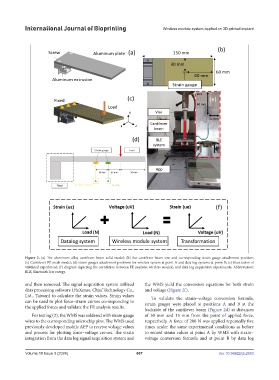
            Figure 2. (a) The aluminum alloy cantilever beam solid model; (b) the cantilever beam size and corresponding strain gauge attachment position;
            (c) Cantilever FE mesh model; (d) strain gauges attachment positions for wireless system at point A and data log systems at point B; (e) illustration of
            validated experiment; (f) diagram depicting the correlation between FE analysis, wireless module, and data log acquisition experiments. Abbreviation:
            BLE, Bluetooth low energy.

            and then removed. The signal acquisition system utilized   the WMS yield the conversion equations for both strain
            data processing software (FleXense, Chief Technology Co.,   and voltage (Figure 2f).
            Ltd., Taiwan) to calculate the strain values. Strain values   To  validate  the  strain–voltage  conversion  formula,
            can be used to plot force–strain curves corresponding to   strain gauges were placed at positions A and B at the
            the applied forces and validate the FE analysis results.
                                                               backside of the cantilever beam (Figure 2d) at distances
               For testing (2), the WMS was soldered with strain gauge   of 30 mm and 15 mm from the point of applied force,
            wires to the corresponding microchip pins. The WMS used   respectively. A force of 200 N was applied repeatedly five
            previously developed mobile APP to receive voltage values   times under the same experimental conditions as before
            and process for plotting force–voltage curves. The strain   to record strain values at point A by WMS with strain–
            integration from the data log signal acquisition system and   voltage conversion formula and at point B by data log


            Volume 10 Issue 3 (2024)                       607                                doi: 10.36922/ijb.2553

