


Page 73 - IJB-10-3
P. 73
International Journal of Bioprinting                                  3D printing technology in neurotrauma


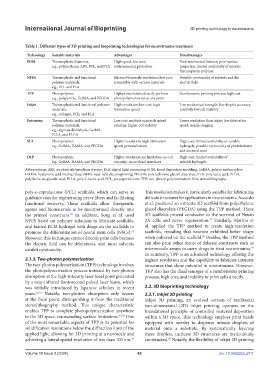
            Table 1. Different types of 3D printing and bioprinting technologies for neurotrauma treatment
             Technology  Suitable materials       Advantages                  Disadvantages
             FDM       Thermoplastic filaments,   High speed; low cost;       Poor mechanical features; poor surface
                       e.g., polyurethane, ABS, PCL, and PLA  environmental protection  properties; limited availability of suitable
                                                                              thermoplastic polymer
             NFES      Thermoplastic and functional   Micron/Nanoscale resolution; low cost;   Possible cytotoxicity of solvents and the
                       polymer materials,         compatible with various materials  electric field
                       e.g., PCL and PLA
             TPP       Photopolymer,              Highest resolution; directly perform   Cumbersome printing process; high cost
                       e.g., polypyrrole, GelMA, and PEGDA  photopolymerization at any point
             Inkjet    Thermoplastic and functional polymer  High resolution; low cost; high   Low mechanical strength; low droplet accuracy;
                       materials,                 fabrication speed           relatively low cell viability
                       e.g., collagen, PCL, and PLA
             Extrusion  Thermoplastic and functional   Low cost; multiple materials mixed   Lower resolution than inkjet; low fabrication
                       polymer materials,         printing; higher cell viability  speed; nozzle clogging
                       e.g., alginate dialdehyde, GelMA,
                       PLLA, and PLGA
             SLA       Photopolymer,              Higher resolution; high fabrication   High cost; limited availability of suitable
                       e.g., GelMA, HAMA, and PEGDA  speed; personalization   hydrogels; possible cytotoxicity of photoinitiator
                                                                              and uncured resin
             DLP       Photopolymer,              Higher resolution; no limitation on cell   High cost; limited availability of
                       e.g., GelMA, HAMA, and PEGDA  viscosity; no artificial interfaces  suitable hydrogels
            Abbreviations: ABS, acrylonitrile butadiene styrene; DLP, digital light processing; FDM, fused deposition modeling; GelMA, gelatin methacrylate;
            HAMA, hyaluronic acid methacrylate; NFES, near-field electrospinning; PEGDA, poly (ethylene glycol) diacrylate; PLA, poly lactic acid; PLGA,
            poly lactic-co-glycolic acid; PLLA, poly-L-lactic acid; PCL, polycaprolactone; TPP, two-photon polymerization; SLA, stereolithography.

            poly-e-caprolactone (PCL) scaffolds, which can serve as   This resolution makes it particularly suitable for fabricating
            guidance cues for regenerating nerve fibers and facilitating   delicate structures for applications in neurotrauma. Accardo
            functional recovery. These scaffolds allow therapeutic   et al. produced an intricate 3D scaffold from polyethylene
            agents and biomaterials to be incorporated directly into   glycol diacrylate (PEGDA) using the TPP method. These
            the printed constructs.  In addition, Song et al. used   3D scaffolds proved conducive to the survival of Neuro
                               50
            NFES based on polymer solutions  to fabricate scaffolds,   2A cells and nerve regeneration.  Similarly, Marino et
                                                                                          57
            and loaded ECM hydrogel with drugs on the scaffolds to   al. applied the TPP method to create high-resolution
            promote the differentiation of neural stem cells (NSCs).    scaffolds, revealing that neurons exhibited better shape
                                                         51
                                                                                       58
            However, this technique cannot directly print cells because   when cultured on the scaffold.  Besides, the TPP method
            the electric field can be deleterious, and most solvents   can also print other forms of delicate constructs such as
                                                                                                            59
            exhibit cytotoxicity.                              microneedle arrays to carry drugs to treat neurotrauma.
                                                               In summary, TPP is an advanced technology offering the
            2.1.3. Two-photon polymerization                   highest resolution and the capability to fabricate intricate
            The two-photon polymerization (TPP) technology involves   structures that show potential in neurotrauma. However,
            the photopolymerization process initiated by two-photon   TPP also has the disadvantages of a cumbersome printing
            absorption at the high-intensity laser focal point generated   process, high cost, and inability to print cells directly.
            by a near-infrared femtosecond pulsed laser beam, which
            was initially introduced by Japanese scholars in recent   2.2. 3D bioprinting technology
            years. 52,53  Notably, two-photon absorption only occurs   2.2.1. Inkjet 3D printing
            at the focal point, distinguishing it from the traditional   Inkjet 3D printing, an evolved version of traditional
            stereolithography method. This unique characteristic   two-dimensional (2D) inkjet printing, operates on the
            enables TPP to complete photopolymerization anywhere   foundational principle of controlled material deposition
            in the 3D space, transcending surface limitations. 54,55  One   within a 3D space. This technology employs print heads
            of the most remarkable aspects of TPP is its potential for   equipped with nozzles to dispense minute droplets of
            solidification resolutions below the diffraction limit of the   material onto a substrate. By systematically layering
            applied light, allowing for 3D printing at a nanoscale and   these  droplets,  intricate 3D  structures are  meticulously
            achieving a lateral spatial resolution of less than 100 nm.    constructed.  Notably, the flexibility of inkjet 3D printing
                                                         56
                                                                         60
            Volume 10 Issue 3 (2024)                        65                                doi: 10.36922/ijb.2311

