


Page 550 - IJB-10-4
P. 550
International Journal of Bioprinting                                   3D-bioprinting of osteochondral plugs


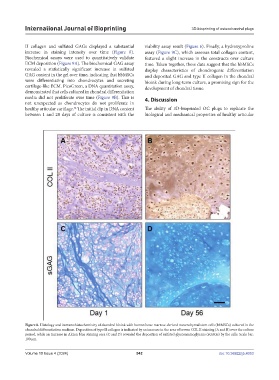
            II collagen and sulfated GAGs displayed a substantial   viability assay result (Figure 6). Finally, a hydroxyproline
            increase in staining intensity over time (Figure 8).   assay (Figure 9C), which assesses total collagen content,
            Biochemical assays were used to quantitatively validate   featured a slight increase in the constructs over culture
            ECM deposition (Figure 9A). The biochemical GAG assay   time. Taken together, these data suggest that the hbMSCs
            revealed a statistically significant increase in sulfated   display characteristics of chondrogenic differentiation
            GAG content in the gel over time, indicating that hbMSCs   and deposited GAG and type II collagen in the chondral
            were differentiating into chondrocytes and secreting   bioink during long-term culture, a promising sign for the
            cartilage-like ECM. PicoGreen, a DNA quantitation assay,   development of chondral tissue.
            demonstrated that cells cultured in chondral differentiation
            media  did not proliferate over time  (Figure  9B). This is   4. Discussion
            not unexpected as chondrocytes do not proliferate in
            healthy articular cartilage.  The initial dip in DNA content   The ability of 3D-bioprinted OC plugs to replicate the
                                54
            between 1 and 28 days of culture is consistent with the   biological and mechanical properties of healthy articular


            Figure 8. Histology and immunohistochemistry of chondral bioink with human bone marrow-derived mesenchymal stem cells (hbMSCs) cultured in the
            chondral differentiation medium. Deposition of type II collagen is indicated by an increase in the area of brown COL II staining (A and B) over the culture
            period, while an increase in Alcian blue staining area (C and D) revealed the deposition of sulfated glycosaminoglycans (sGAGs) by the cells. Scale bar:
            100 µm.


            Volume 10 Issue 4 (2024)                       542                                doi: 10.36922/ijb.4053

